


The Weaver’s Moon

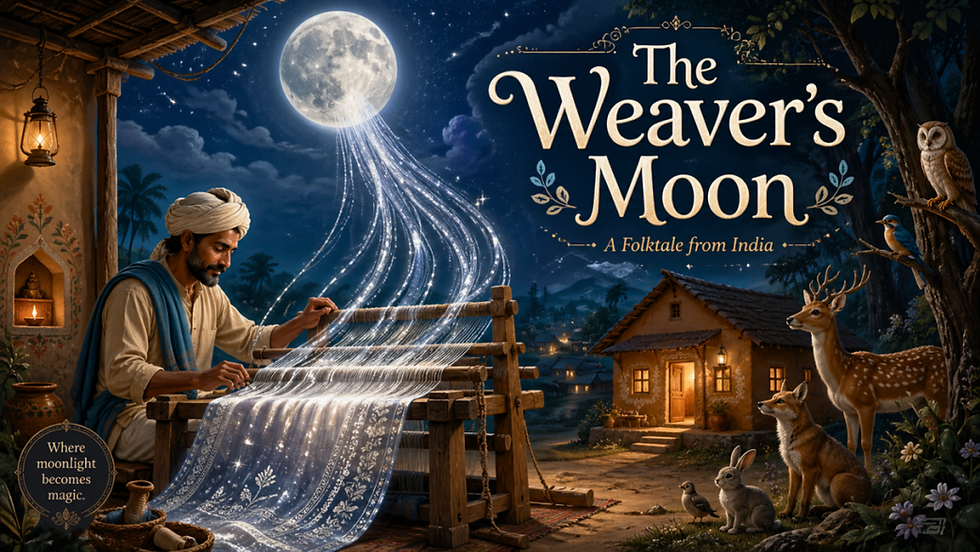
Long ago, in a village where the river curved like a silver anklet, there lived a weaver named Nimai who could make cloth so fine that even the breeze felt shy touching it. His saris carried colors of dawn, mustard fields, parrot wings, and wet earth. Yet Nimai remained poor, because he sold fairly, gave freely, and often forgot to ask payment from widows, priests, wandering singers, and anyone who praised the border design with enough feeling.
His wife, Kamala, kept the house running through skill sharper than any needle. “Your kindness has holes,” she told him, counting coins one evening. “Good cloth tears if woven loose.” Nimai smiled. “Then you must mend me.”
They had one daughter, Bela, who loved the loom’s music: tak-tak, jhirr-jhirr, tak-tak. She could identify dyes by smell and threads by touch. One year, floods ruined the cotton crop. Prices rose. Merchants came from town offering rough thread at cruel rates. “Buy now,” said a merchant with oily hair, “or close your loom.” Nimai refused. “Your rate will starve the village.” The merchant shrugged. “Hunger is also a market.”
Days passed. The loom fell silent. Bela hated the silence. On the night of the full moon, she saw her father sitting outside, looking at his empty hands. “Baba, can moonlight be woven?” she asked. Nimai laughed softly. “If it could, your mother would have asked me to make curtains from it.” Kamala, from inside, said, “And sell the leftovers to pay debt.”
Bela walked to the riverbank. Moonlight lay on water in trembling strips. She dipped her fingers in and lifted them. For a moment, silver threads clung to her skin. A voice from the reeds said, “Do not waste what you cannot name.” Bela turned. An old woman sat there, combing long white hair with a fishbone comb.
Her eyes shone like river stones. “Who are you?” asked Bela. “A neighbor of the night.” “Can you teach me to weave moonlight?” “I can teach you to gather it. Weaving depends on your house.” The old woman gave Bela a clay spindle. “Spin only when the moon is full. Take only what falls on water. Never pull from the moon itself. Greed tears the sky.”
Bela ran home with the spindle. Nimai and Kamala listened, exchanged worried looks, then followed her to the river. Silver strands rose from water when the spindle turned. By dawn, they had a small bundle of shining thread, cool as lotus petals. Nimai set it on the loom. The thread resisted at first, slipping away from knots, but Bela sang the loom rhythm, Kamala steadied the warp, and Nimai guided the shuttle. They made a cloth that seemed plain in shadow but under light revealed clouds, fish, birds, and the curve of the river.
The village gathered. “Sell it to the king,” someone said. “Sell it to the temple,” said another. “Sell it to the merchant and buy cotton,” said Kamala. The oily-haired merchant arrived by noon, drawn by rumor. His eyes widened. “I will take all you can make.” “We have made one,” said Nimai. “Then make one hundred. I will pay well.” He named a sum large enough to repair the roof, buy grain, and silence debt. Kamala’s fingers tightened on her sari end.
Nimai looked at Bela. Bela thought of the old woman’s warning. “Only during full moon,” she said. “Only from water.” The merchant smiled. “Children believe rules. Adults count profit.” He offered advance money. Nimai refused, though his voice shook. That night, the merchant sent men to watch the river. They saw Bela spin moonlight from the water and reported everything.
On the next full moon, the merchant came alone with twenty spindles. He waded into the river and began spinning furiously. Silver threads rose. He laughed. “The sky is rich.” He spun faster. The water darkened. Fish leapt in distress. Clouds crossed the moon. From the reeds came the old woman’s voice, stern as thunder. “Enough.”
The merchant ignored her. He lifted a spindle toward the moon and pulled. A ripping sound crossed the sky. For one terrible moment, the moon’s face dimmed. The river recoiled. The silver threads in the merchant’s hands turned into pale snakes of water, wrapping his arms and legs. He screamed. Bela ran forward, but Kamala held her back.
Nimai stepped into the river. “Mother of the night, spare him. Greed has already punished him with itself.” The old woman emerged from the reeds, taller now, her hair flowing into mist. “Then let him repay what he tried to steal.” She touched the water. The merchant fell onto the bank, soaked, shivering, his fine clothes turned gray. His twenty spindles became reeds. His money bag became a clay pot full of river mud.
From that day, he could trade only at fair price; whenever he lied in bargaining, his tongue tasted mud. This improved his character more quickly than sermons. Nimai wove one mooncloth each full moon. He sold them at honest price, using part of the money to buy cotton for other weavers. Bela learned dyes, accounts, and sky rules. Kamala managed the sales so cleverly that no one cheated them twice. The village prospered. Brides wore moon borders on wedding saris. Newborns slept under small mooncloth squares. Fishermen tied silver threads to their nets for safe return.
Years later, when Bela became the finest weaver in three districts, children asked her whether the old woman was a fairy, river spirit, goddess, or grandmother of the moon. Bela smiled and turned her spindle. “Names are small baskets,” she said. “Some beings spill over.” On full moon nights, if the river is calm and greed is far away, silver threads still rise where moonlight touches water. But only patient hands can gather them, and only generous houses can weave them into cloth.
Author’s Note : “These stories are conceived, directed, edited, curated, and finalized by Kallol Saha. Generative AI tools are used as creative assistants for drafting, language refinement, visual ideation, and structural experimentation.” Final selection, editing, narrative judgment, and publication responsibility remain with the author.”
Creative Commons Attribution 4.0 International, CC BY 4.0
Comments