


One Earth Weekly Top Ten
- Development Connects

- Apr 27
- 3 min read
Earth, environment and planetary science Updates : 17th to 24 th April , 2026
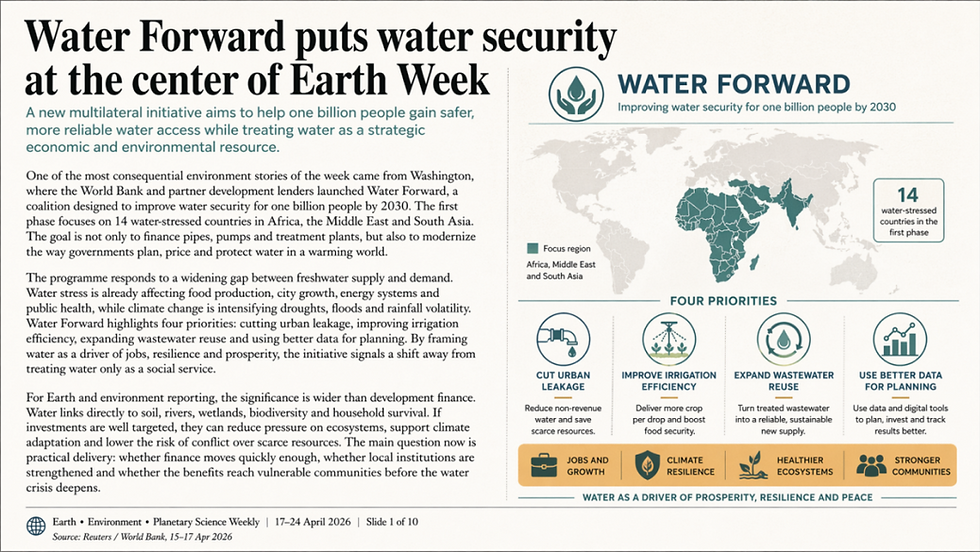
The World Bank and partner development lenders launched the Water Forward initiative, aiming to improve water security for one billion people by 2030. Its first phase will focus on 14 water-stressed countries across Africa, the Middle East and South Asia. The programme is built around reducing urban leakage, modernising irrigation, expanding wastewater reuse and using better data for planning. Its deeper significance is that water is now being treated not only as a public service, but as a strategic resource linked to jobs, food security, climate resilience and peace.
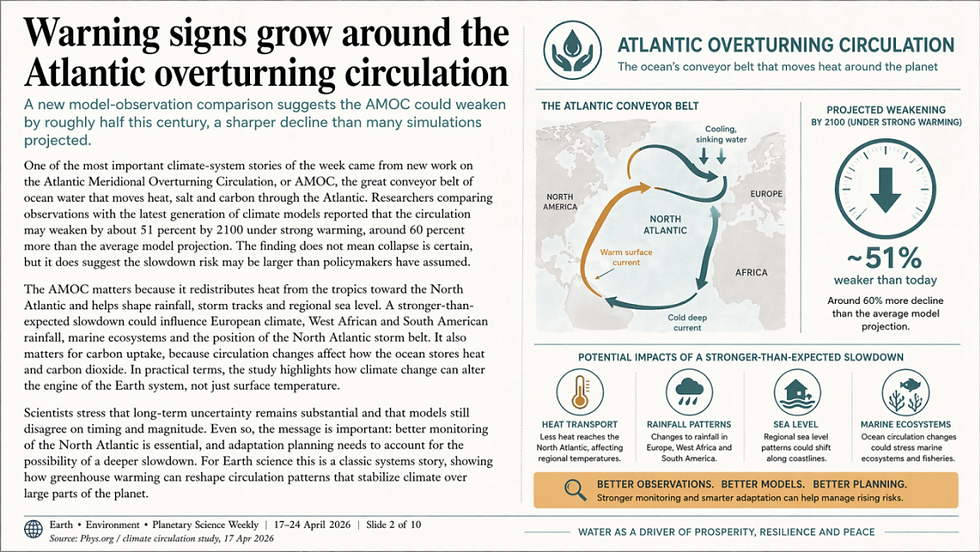
Ocean science brought a more worrying signal. New research on the Atlantic Meridional Overturning Circulation, the great conveyor belt that moves heat, salt and carbon through the Atlantic, suggested that it may weaken by about 51 percent by 2100 under strong warming. That is sharper than many model-only estimates. A weakened AMOC could affect European temperatures, rainfall across Africa and South America, regional sea levels and marine ecosystems. The study does not prove collapse, but it warns that climate planning must account for deeper circulation risks.
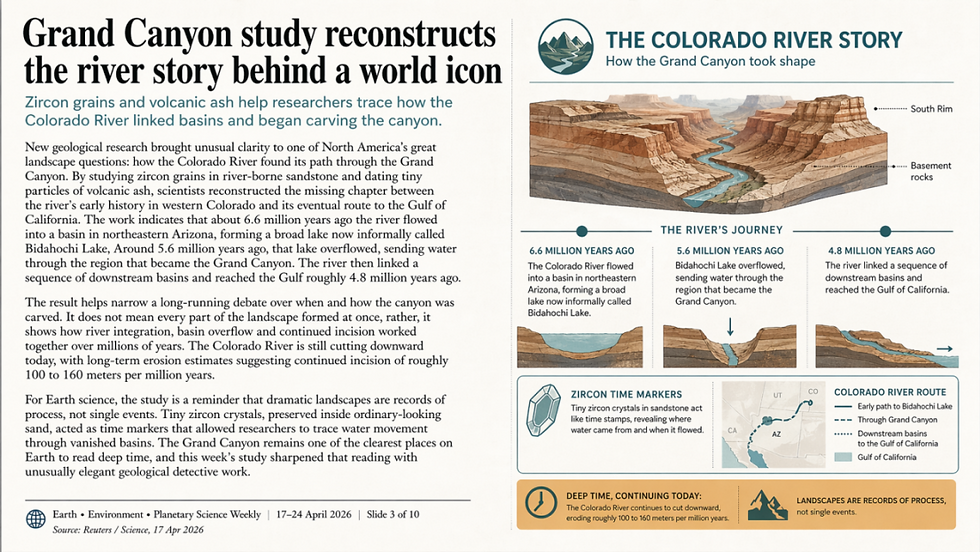
On land, geologists refined the story of the Grand Canyon. By studying zircon grains and volcanic ash, researchers reconstructed how the Colorado River linked ancient basins before carving through the canyon. Their work suggests the river entered a basin in northeastern Arizona about 6.6 million years ago, overflowed through the Grand Canyon region around 5.6 million years ago, and reached the Gulf of California roughly 4.8 million years ago. Tiny crystals in sand became time markers for one of Earth’s greatest landscapes.
Radar and satellite observations of the 2018 Camp Fire showed that embers were not falling randomly. They were carried in organised plume-driven zones and ignited spot fires 5 to 10 kilometres ahead of the main fire front. This finding could improve forecasting, evacuation planning and firefighter safety in a hotter, drier world.

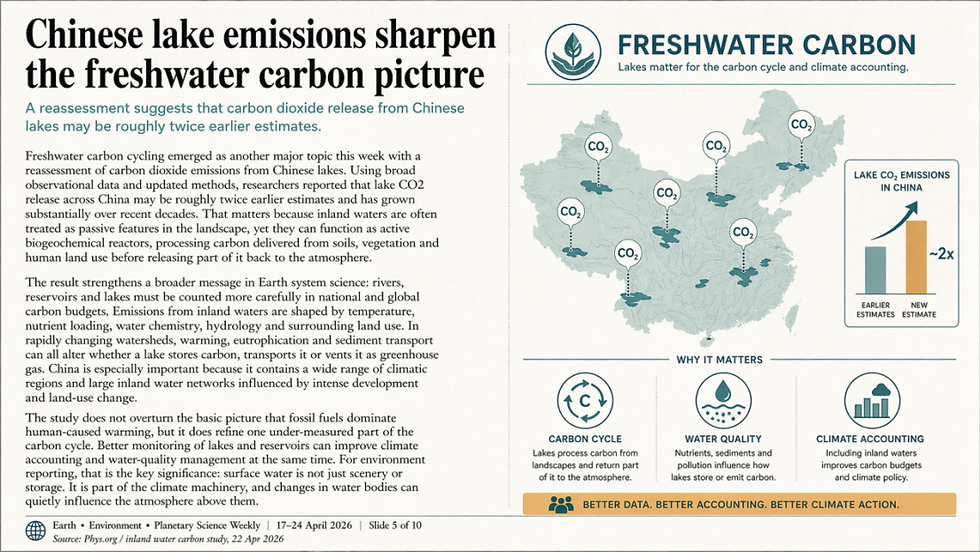
Freshwater carbon research added another climate accounting lesson. A reassessment of Chinese lakes suggested that their carbon dioxide emissions may be roughly twice earlier estimates. Lakes, reservoirs and rivers are not passive scenery; they are active parts of the carbon cycle, shaped by temperature, nutrients, land use and hydrology.
Volcanology offered a similar caution. Methana in Greece, long quiet at the surface, showed signs of heat, gases and subsurface activity. The message was modest but important: quiet volcanoes are not necessarily dead, and monitoring matters.

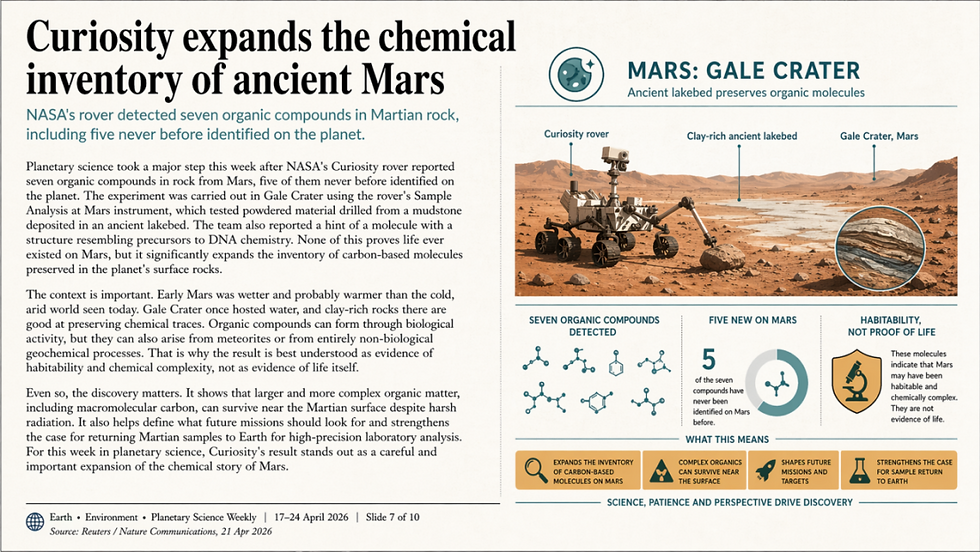
Planetary science gave the week its cosmic reach. NASA’s Curiosity rover detected seven organic compounds in Martian rock, including five never before identified on Mars. The discovery does not prove life, but it strengthens evidence that ancient Mars had habitable chemistry.
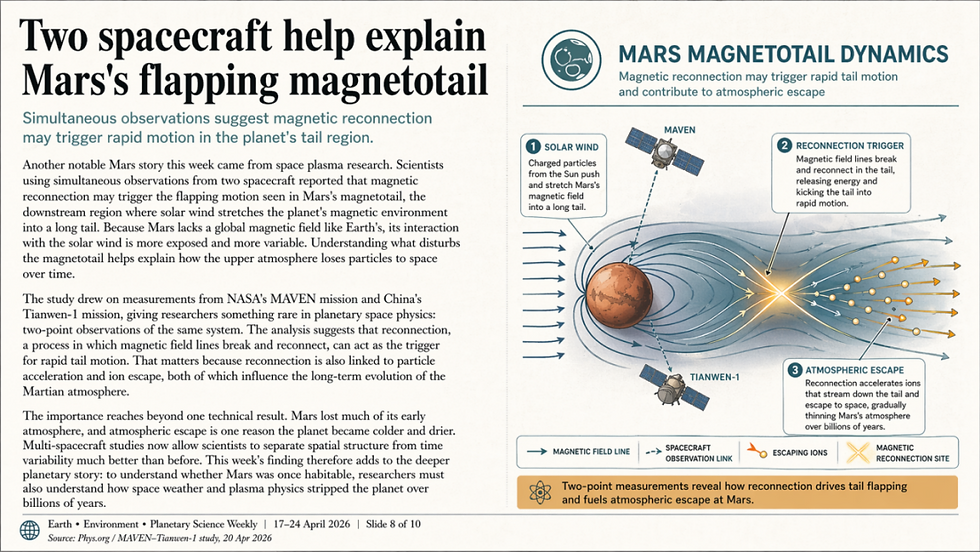
Another Mars study, using MAVEN and Tianwen-1 observations, suggested magnetic reconnection may trigger flapping in Mars’s magnetotail, helping explain atmospheric escape over billions of years.
Titan reminded scientists how strange other worlds can be. A new model suggested gentle winds could raise 10-foot waves on methane-ethane lakes because of Titan’s low gravity, dense atmosphere and light liquids. Meanwhile, the Lyrid meteor shower and comet 3I/ATLAS kept public skywatchers engaged.

Taken together, the week’s science told one story: whether looking at water security, ocean circulation, wildfire behaviour, volcanic risk or distant worlds, better observation is changing how humanity understands both Earth and its planetary neighbours.


Comments