


Women’s Reservation Must Not Be Held Hostage to Delimitation Politics
- Development Connects

- Apr 19
- 3 min read
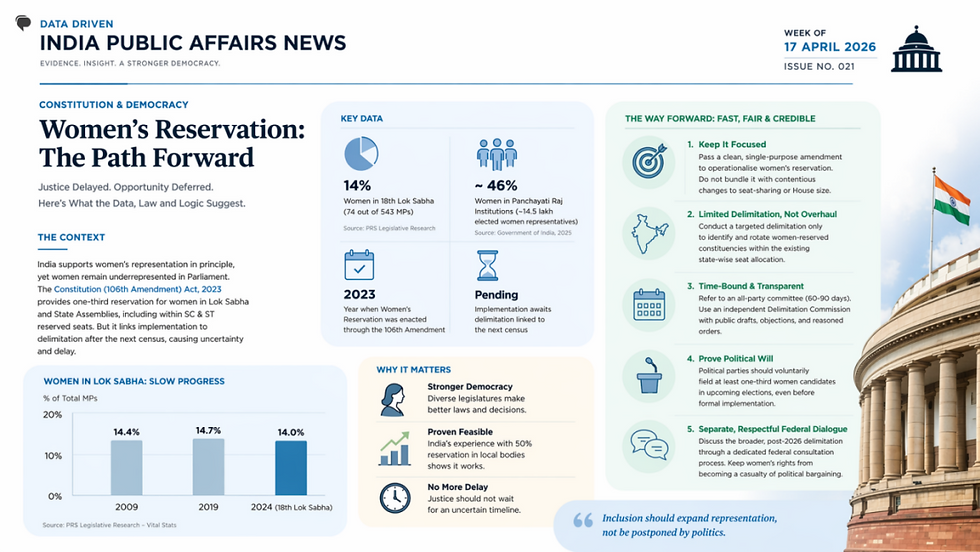
India does not need another symbolic endorsement of women’s political representation. It needs implementation. The constitutional principle is already settled: the Constitution (106th Amendment) Act, 2023 provides one-third reservation for women in the Lok Sabha, State Assemblies, and the Delhi Assembly, including within SC and ST reserved seats. But the same law also postpones implementation until after delimitation based on the first census figures published after the Act’s commencement. In effect, India accepted the destination but built delay into the road map.
That is why the right question is no longer whether women’s reservation is justified. It clearly is. The real question is how to operationalise it quickly, fairly, and in a way that the country can trust. The failed 2026 delimitation package showed exactly what should be avoided. PRS notes that the Constitution (131st Amendment) Bill, 2026 would have done far more than merely activate women’s reservation: it would have allowed Parliament to decide when delimitation should happen and which census to use, raised the maximum size of the Lok Sabha from 550 to 850, and potentially shifted the balance of seats among states by moving toward a more current population basis. That transformed a justice issue into a federal power struggle.
This bundling is politically clever but constitutionally unwise. Women’s reservation is a democratic reform. Delimitation among states is a structural reallocation of political weight. The two need not be tied together. Once they are fused, every actor gets a ready-made excuse. Some can oppose the package in the name of federal fairness while claiming to support women in principle. Others can present themselves as champions of women while using the issue to push through a much larger redesign of representation. The result is predictable: women remain underrepresented, while parties compete in moral posturing.
The ideal course is therefore straightforward. Parliament should pass a narrowly tailored constitutional correction or enabling framework that preserves the one-third reservation already enacted, but separates it from contentious inter-state seat redistribution. In practical terms, that means conducting a limited delimitation exercise only for identifying and rotating women-reserved constituencies within the existing seat structure, without changing the present state-wise allocation of Lok Sabha seats for now. That would respect the constitutional commitment to reservation while preventing the reform from becoming collateral damage in a North-South seat battle. This is an inference from the current framework, but it follows directly from the fact that the 2023 law has already accepted reservation as policy and only leaves commencement to delimitation mechanics.
Such a route would also be justified by democratic reality. Women still remain significantly underrepresented in Parliament. PRS’s current profile of the 18th Lok Sabha shows that only 74 women were elected, about 14% of the House. For a country that regularly celebrates women’s leadership in local governance, this number is too low to be defended as organic progress. It reflects structural barriers in ticket distribution, party hierarchies, and winnability calculations. In other words, waiting passively for parties to self-correct is not a serious strategy.
A credible implementation path should have five elements. First, the Union government should introduce a clean, single-purpose amendment or legal mechanism with no hidden structural redesign. Second, the proposal should be examined through a short, time-bound all-party parliamentary process so that technical concerns such as rotation, constituency selection, and transition timing are settled transparently. Third, the actual exercise should be carried out by an independent Delimitation Commission using published criteria, draft proposals, and opportunities for objections. Fourth, parties should voluntarily commit to fielding at least one-third women candidates even before the constitutional reservation formally begins, to prove sincerity. Fifth, the larger question of post-2026 national delimitation should be addressed separately through explicit federal consultations rather than being smuggled into a women’s rights debate. These are normative recommendations, but they are anchored in the constitutional and legislative problems exposed by the 2023 and 2026 frameworks.
There is also a moral reason to proceed this way. Women’s reservation should not be made to wait for an ideal political climate, because that climate never arrives. Nor should it be used as a shortcut to force through a broader representational redesign that many states view with suspicion. Justice is not served when one reform is made dependent on another unresolved conflict. A mature democracy should be able to say two things at once: women deserve representation now, and federal fairness must be handled with care.
The earliest justified path, then, is not theatrical legislation but disciplined constitutional workmanship. India should keep the one-third reservation intact, avoid immediate state-wise seat redistribution, conduct a limited and transparent delimitation only to operationalise the quota, and apply it from the next election cycle. That would be fast, fair, and much harder to dismiss . Let us act now to ensure Women’s representation bill enter Parliament through the front door of constitutional democracy, from policy to practice.


Comments