


The Village That Held a Meeting About Meetings
- Development Connects

- Apr 7
- 3 min read
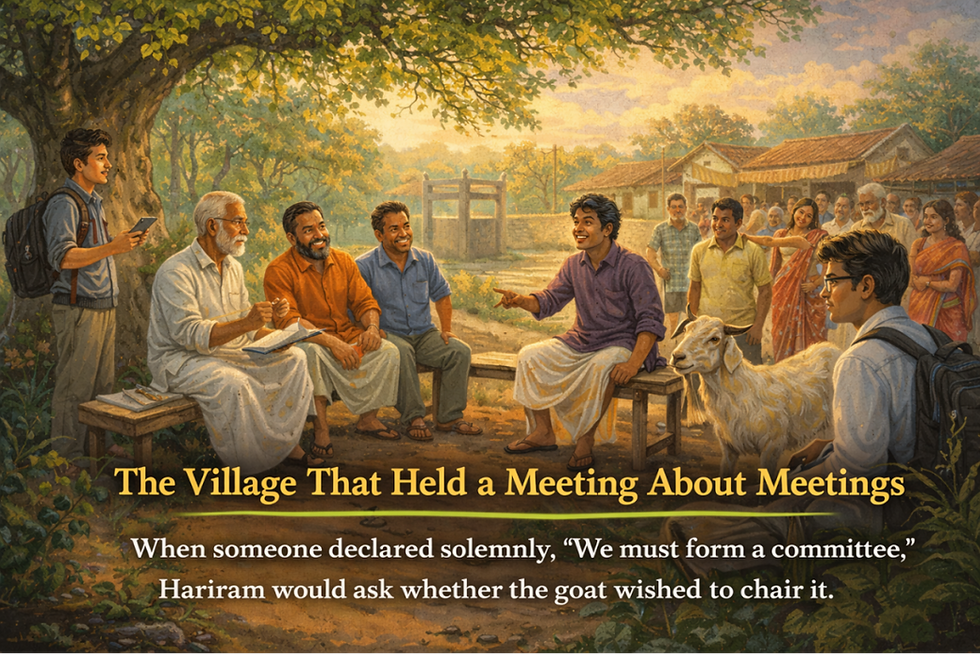
In the eastern corner of the village square stood a neem tree older than anyone alive. Beneath it lay three wooden benches, uneven in height, polished by decades of arguments, reconciliations, and tea spills. That was where governance unfolded.
It began with something practical. The canal gates had to be opened two hours earlier for the winter crop. A meeting was called.
The meeting lasted three hours.
By the end, nothing had been decided, but four subcommittees had been formed.
A week later, there was another meeting — this time to clarify the objectives of the subcommittees. Attendance dropped slightly. The excuse was harvesting. The real reason was fatigue.
Then came the idea that changed everything: a “Coordination Review Meeting to Improve the Efficiency of Future Meetings.”
The village secretary arrived early that day, carrying three files and a new pen purchased specifically for the occasion. He had drawn up an agenda with bullet points, subpoints, and a concluding paragraph in impressive handwriting.
Hariram arrived ten minutes later, walking slowly, wiping his hands on his gamcha.
“What is today’s emergency?” he asked.
“We are improving structure,” replied the secretary with quiet pride.
“Structure?” Hariram glanced at the leaning benches. “Start with these.”
Others trickled in. A goat followed, uninterested in governance but highly interested in shade.
The schoolteacher proposed a time limit for speakers. The young graduate suggested digital attendance. Someone recommended biometric verification, which sounded important, though no one quite knew what it meant.
A small machine was borrowed from the nearby block office.
The next meeting began with great ceremony. Each villager pressed his thumb against the glowing surface. The machine blinked, beeped, and politely rejected nearly every fingerprint.
“Fingerprint mismatch,” it announced with bureaucratic indifference.
The villagers examined their cracked hands. Soil had lived in those lines longer than electricity.
The machine was retired.
A notebook returned.
Weeks passed. Meetings multiplied gently like monsoon mushrooms. There were discussions about fertilizer, discussions about why fertilizer had been discussed incorrectly, and discussions about whether discussions were becoming excessive.
And yet, beneath the neem tree, something softened.
The laughter grew easier. Sarcasm replaced irritation. When someone declared solemnly, “We must form a committee,” Hariram would lift an eyebrow and ask whether the goat wished to chair it.
The goat, punctual and silent, attended every session without protest.
No reform had dramatically reduced the number of gatherings. No efficiency model transformed rural administration. The canal gates were still opened by the same iron lever, pulled by the same calloused hands.
But the meetings had become lighter.
They no longer felt like burdens descending from distant offices. They felt like shared theatre — predictable, flawed, familiar.
And in the quiet afternoons, when the neem leaves stirred and the benches rested empty, the square seemed to remember all the voices that had risen and fallen there — the earnest proposals, the exaggerated grievances, the sudden laughter breaking through solemn debate.
Governance in that village did not become perfect.
It became human.
And as the sun leaned westward and shadows lengthened across the courtyard, the secretary would close his file with less urgency than before. Hariram would rise slowly, stretching his back, glancing at the sky not for digital confirmation but for instinctive assurance.
The goat would leave first.
Evening descended gently, like a patient listener withdrawing without interruption.
Under the wide and forgiving sky, the village carried on — not improved by systems alone, nor defeated by inefficiency, but bound together by the simple fact that they still gathered, still argued, still laughed beneath the same tree.
There are places where decisions are written in ink.
And there are places where they are carried in memory, softened by wind, and revised by time.
The neem tree remained.
And so did they.


Comments