


The Great Indian Bengali Stories : Dakshin Ray

Chatujye-moshai said, “If you speak of tigers, then speak of the tiger of Rudraprayag. A truly weeping, sentimental fellow! In summer he goes there from the Sundarbans for a change of air. But such is the sanctity of the place that he does not touch ordinary people; after all, they are pilgrims. He eats only sahibs, by the roadside.”
Binod, the pleader, said, “A patriotic tiger, then. Could we not import a few of that species here? Swaraj would arrive in no time. No need of swadeshi, bombs, charkhas, council-breaking, or any of that bother.”
It was evening in Bansholochan Babu’s sitting room. Bansholochan himself was reading an English book with deep absorption. His brother-in-law Nagen and nephew Uday were also present.
Chatujye-moshai took a one-minute pull at the hookah and said, “And what makes you think that attempt was never made?”
“Was it?” cried Binod. “But I never saw anything of the sort in the Rowlatt Report.”
“A fine report you have read! Do you suppose Government prints everything at eight annas a copy? There are matters which Government keeps under its own turban.”
“Then please open the matter fully.”
Chatujye remained grave for a little while. Then he said, “Hm.”
Nagen said, “Do tell us, Chatujye-moshai.”
Chatujye rose, peeped through the doors and windows, and returned to his seat. Again he said, “Hm.”
Binod asked, “What were you looking for?”
Chatujye replied, “I was seeing whether that Haren Ghosal had suddenly turned up. He is a police spy. A little caution beforehand is always wholesome.”
Bansholochan laid aside his book and said, “Perhaps it is better not to discuss such affairs. In a magistrate’s house such stories are not quite safe.”
“Quite right,” said Chatujye. “Besides, the matter is highly supernatural. It will make the hair stand up like the bristles of a new broom. No, let it pass. By the way, Uday, when is your wife returning from her father’s house?”
But Binod cut Uday short and said, “Where is the harm in hearing it? Come to my house. There is no magistrate there.”
“No, no,” said Bansholochan. “Let it be told here. Only, Chatujye-moshai, please omit the more seditious portions.”
“Fear not,” said Chatujye-moshai. “I shall omit, prune, disinfect, and boil before serving. It was not so very long ago. You have perhaps heard the name of Baku Dutta—of our Majilpur, related to Charan Ghosh—”
“Bakulal Dutta?” said Binod. “The man whose great house in Kapalitola is being broken by the Improvement Trust? I heard he died of grief because he could not enter the Council.”
“Rubbish!” said Chatujye. “Baku Babu is alive, though no longer quite recognizable. For one anna you may see him. Only on Sunday afternoons the charge is one rupee.”
“What do you mean?”
“The poor fellow destroyed everything through want of intelligence. Such honour, such wealth! He had obtained the grace of Baba, but in the end his mind became clouded.”
“Which Baba?”
“Baba Dakshin Ray.”
Uday said, “I have an uncle-in-law named Dakshinamohan Ray.”
“Uday,” said Chatujye, “you have made me laugh; indeed you have. Not an uncle-in-law, you pumpkin! A deity. A raw-meat-eating deity. The god of tigers.”
Chatujye folded his hands and touched his forehead three times. Then, in a solemn nasal tune, he began:
I bow to Dakshin Ray, who in the Sundarbans resides,Among reeds, marsh and hogla grass through twelve long months he hides.To south lies Jhakdwip, Shahabazpur’s shore,To north the Bhagirathi flows for evermore.To west lie Ghatal’s fields, to east Balasore’s plain,Within these holy borders the Lord begins his reign.
Cow-tiger, saint-tiger, leopard, lanky striped lord,Tree-tiger, black-tiger, sand-tiger broad;Spotted, dotted, striped and patched in varieties most fine,Three hundred sixty-three houses form His divine line.
Each dark moon night His revenue is due;Buffalo and boar the tenants bring in queue.All night drums thunder, dancers twist and spring,The jungle roars open and ten directions ring.
Six tiger minstrels, thirty-six tigresses fair,Sing in turmeric raga with a most ferocious air.Lumps of sacred meat does Lord Dakshin throw,And all bite thankfully, with devotional glow.
In His service living creatures perish day by day,At every watch of night bile rises in the bay.Great beasts He swallows with most excellent speed;From violence His complexion turned yellow indeed.
Goat, swine, cow, Hindu and Mussalman,All become equal in the Lord’s abdomen.Most learned is He, no caste-difference knows;On all living beings His impartial hunger flows.
Mercy, O Dakshin Ray, grant this boon at last:May I not meet Thy paw when my final hour is cast.
Binod said, “Where did you get that panchali?”
“From Raymangal,” said Chatujye. “I possess a manuscript three hundred years old. Chimesh Mitter is hanging about to get it. The young fellow wants to write a thesis on it and become a university doctor. He offered up to one hundred and fifty rupees. I refused. If a thesis is to be written, I shall write it myself. I possess pulse-knowledge. If I become a doctor in old age, it will be some provision for the future.”
“Very good,” said Binod. “Proceed.”
“I was speaking of Baku Babu. Fifteen years ago his condition was not flourishing. His family lived in the country; he stayed in a Calcutta mess and worked in the office of Ramjadu Attorney at a salary of eighty rupees. Ramjadu Babu was his class-friend, hence the appointment. Now Baku Babu had somewhat sticky fingers. Having accepted a little refreshment from the opposite party, he delayed serving a summons. Ramjadu Babu was a stern man. Friendship from boyhood did not soften him. On learning the affair, he insulted Bakulal beyond all measure. Baku Babu, in a blaze, resigned and came back to his lodgings.
“His mind was gloomy. He told the mess cook that he would eat nothing that night. Then he went to Hedua to cool his head. In anger he had left his job, but how was the household to run? Capital was trifling. Against Ramjadu his rage became tremendous. In an attorney’s office, he thought, many people take a small side-income now and then. Is that any reason to insult an old friend? Very well. One day Bakulal would take revenge.
“At nine o’clock he returned to the mess. The place was empty. It was Saturday; all the mess members had gone to the theatre. Bakulal entered silently and saw inside the kitchen—”
Nagen said, “Dakshin Ray?”
“In the kitchen,” continued Chatujye, “the mess maid was sitting on Baku Babu’s woollen seat—the very seat knitted by his wife—and eating luchis from his own plate, while the mess cook fanned her. The maid bit half a cubit of tongue and pulled a cubit and a half of veil. On another day Baku Babu would have raised Kurukshetra. But today he saw and yet did not see. Quietly he went upstairs and lay upon his bed.
“Then began profound thought. What was to be done? From where would money come? He had a widowed aunt at Hooghly, vastly rich, with only one heir, a son named Tuto. That Tuto was a most ruined young fellow and had gone downhill early in life. But the aunt was mad about him and did not even glance at such a deserving nephew as Bakulal. No hope from that old lady.
“Bakulal thought: What justice has God! That worthless Tuto will own ten lakhs, while his maternal cousin Baku must starve on flattened rice and arithmetic. That villain Ramjadu, his own class-friend, is making lakhs by cheating clients, while he must hunger for a petty job. Hang God!
“But Baku had heard from one devout friend that if one called upon God with single-minded devotion, God fulfilled the devotee’s desire. Well then, why not try once?
“No sooner said than done. Bakulal sprang up, lit the stove, made tea, and drank three cups. Tonight he would call upon God till dawn.
“He put out the light, leaned upon his bed, and began austerity. ‘O Hari, lover of devotees! O Brahma! O Mahadev! Have mercy. In former times you listened to the demands of devotees. Why should you now turn away from this poor man? O Durga, Kali, Lakshmi—any one of you can set me up if you like. Give me a boon. Not much. Only one lakh. No, one lakh will not do. My wife will have ornaments made and swallow half of it. That Ramjadu rascal must have ten lakhs at least. I require at least five lakhs—no, no, ten lakhs. O gods, to you one lakh and ten lakhs are the same. The universe will neither gain nor lose by it. You give crores to many people. Give me only ten lakhs.
“‘One lakh for a house. Fifty thousand for furniture. Another fifty thousand for this and that. A good motorcar, say. No, one motorcar will not do. My wife will monopolise it and go to theatre and Ganga-bathing all day. Let a Ford be allotted to her. A second-hand Ford. Too much comfort is not good for women.
“‘And that Ramjadu—if someone could bring the rascal tied up, I would rub his flat face upon the footpath. Rub and rub until eyes, nose and mouth became one oily surface. O Buddha, Jesus Christ, Chaitanya, forgive me for tonight. I know you do not approve these matters. O fathers, do not interfere with my austerity tonight; later I shall make one day happy for you too. O Narayan, O Keshav, O Prophet, O Jehovah of the Jews, O Ahura of the Parsis, gods, demons, yakshas, rakshasas, Satan—Ram! Ram! But what objection even to Satan? At worst I shall go to hell. One cannot be too particular in business. O any one among the thirty-three crores, have mercy! I call with my whole heart—Dhanam dehi, dhanam dehi! Give money, give money!’”
Binod interrupted, “Chatujye-moshai, how did you know Baku Babu’s thoughts?”
“That,” said Chatujye, “you people will not understand. This is the Kali age, true, but two or four genuine Brahmins still exist. I may be poor, but I am of Kashyap gotra and descendant of Padlakar Thakur. In these old bones of Kedar Chatujye the powder of sages still remains. With a little effort I can tell what is cooking in a man’s pot; the contents of his mind are a mere trifle.
“Now Bakulal Babu continued such single-minded austerity. Tears flowed from both his eyes. He had no outer consciousness. Only one cry—Dhanam dehi! At that moment from below came a sound—ting-ting.
“Bakulal leapt up, lit a match, stood in the verandah, and threw light into the courtyard. He saw—”
Nagen, thrilled, again cried, “Dakshin Ray!”
Chatujye made a face and said, “Dakshin Ray! Your head! Why do you not tell the story yourself? Why should I die babbling?”
Uday said joyfully, “This is exactly Nagen-mama’s fault. He never lets a man speak. On the day of my sister-in-law’s final betrothal—”
“Oh, gone!” cried Chatujye. “One stops and another begins. No, I shall say no more.”
Binod said, “Why do you fellows interrupt the sacred flow? Let the Brahmin speak.”
Chatujye resumed. “Bakulal Babu saw in the courtyard—neither Shiva’s bull nor Vishnu’s Garuda nor any such party. Only in one corner stood a red bicycle leaning against the wall. He called, ‘Who is there?’ The telegraph peon, who had gone to knock at the staircase door, now came forward and said, ‘Telegram.’
“What telegram? Baku Babu’s heart began to thump. He had not bought a lottery ticket. Then was his wife ill? Or some child? But only that afternoon he had received a letter saying all were well. Bakulal came down in a tumble.
“The telegram said: Tuto suddenly dead. Aunt also sinking. Come at once.
“Baku Babu cried ‘Ya Allah!’ and sprang up. Then he took out his purse and emptied it into the peon’s hand. The poor peon had known before coming that it was bad news and that no tip could be expected. Receiving unasked three rupees and six annas, he thought the gentleman’s head had gone wrong from grief. He took the signature and fled.
“So Tuto was dead! Truly dead! Ah, Tuto, splendid boy! Surely the liver had rotted with drink. A grand shraddha would have to be performed.
“That very night Baku Babu left for Hooghly. His fortune turned, though not by ten lakhs—only five. At first the smallness of the sum caused some mental churning, but gradually he became reconciled. There was a house, there was a car, there was everything. Bakulal launched various businesses. Then came the War. He began supplying the same goods five times over. Dust in hand became gold in hand. There was no end to money. But with increase of age Baku’s intelligence became thick.
“In this manner fourteen years passed.”
Here Chatujye-moshai pulled at his tobacco and took breath.
Binod said, “But where is the tiger, Chatujye-moshai?”
“It will come, it will come,” said Chatujye. “Do not be restless. When the proper hour strikes, the tiger also strikes.
“On the night Baku Babu entered his fifty-fifth year, Mother Bengal appeared to him and said, ‘Son Baku, your age is considerable and your money has accumulated in heaps. But what have you done for the country?’
“Bakulal replied, ‘Mother, I am an unworthy son. I cannot make speeches. For fear of malaria I cannot go to the country. Khaddar does not suit me—my body is tender—even a dhoti from a native mill cuts my stomach. And as for bombs, leave bombs aside, I have not the courage to throw even a children’s cracker. Tell me yourself what my duty is. I cannot undertake labour at this age. If there is anything easy, say it, Mother.’
“Mother Bengal said, ‘Enter the Council.’
“Mother said it and was free. But how was one to enter? Baku Babu fell into great perplexity. After much thought he approached an influential sahib and said he was willing to donate three thousand rupees to the Drunken Sailors’ Home if Government would nominate him to the Council. The sahib said he would gladly take the money, but could make no promise, because Government did not accept bribes from just anybody.
“Baku Babu returned with a lemon-coloured face. Next he approached a political leader. ‘I wish to stand in the election,’ he said. ‘Admit me into your party. Give me whatever creed there is, I shall sign it.’
“The leader said, ‘Hang creed! First produce one lakh of rupees for our All-Bengal Snake-Destruction Fund. If we do not kill snakes, why should the villagers support us?’
“Baku Babu said, ‘Shame, shame! To serve the country, must I pay money? I do not give bribes.’ He returned home and decided that all fellows were thieves. If expenditure had to be made, he would spend it himself and with discretion.
“Finding no facility in Calcutta, Baku Babu resolved to stand from the South Sundarban Constituency. He had recently purchased some zamindari there, and therefore votes would be easier to collect. Two or three months before the election he plunged into work.
“Then suddenly came news that his old enemy Ramjadu Babu had overnight put on a khaddar suit and begun making speeches. He too would stand from the Sundarbans. Baku Babu’s determination doubled. He bought a number-three top-knot from Tiretta Bazaar, tied two cows in his gateway, and arranged for cow-dung cakes to be stuck upon the railing of his house.
“In the newspapers various scandals began to appear. Who knows Bakulal Dutta? Fourteen years ago under whom was he employed? Why did that employment end? How did a clerk obtain so much money? O countrymen, why does Bakulal Dutta buy soda-water? With what does he mix it? Why are lights burning at night in Baku’s garden house? Baku is dark; how then is his youngest son fair? Beware, Bakulal! Do not try to compete with Sri Ramjadu. Otherwise many more facts shall be revealed.
“Baku Babu also printed replies, but they were not so effective, for his side possessed no literary secret-agent of sufficient vigour.
“Gradually Baku Babu understood that he was sinking. The voters were shaking their heads at him. One day, while seated in great discouragement, he remembered that fourteen years earlier his fate had changed through divine mercy. Could it not happen again? He resolved to call upon the thirty-three crores once more, with body, mind and speech. It would not do to rely only upon Mother Bengal, for she was not an actual deity; she had been manufactured on Bankim Chatterjee’s roof. She had no real qualification except that she could excite people.
“At ten o’clock at night Baku Babu entered his office room and told the doorkeeper that he had much work and no one should disturb him. This time not in the bedroom, for if his wife were present there might be obstruction to austerity.
“Bakulal lay down in an easy-chair and submitted a prayer of the following substance: ‘O Brahma, Vishnu, Maheshwar, Durga, Kali, and others, you once preserved my honour. I too gave you proper worship. Afterwards, owing to various businesses, I could not make regular inquiries after you. Do not mind, fathers. My wife, however, has always supplied you with bananas, radishes, and sundry articles. She has also given some gold and silver. That silver bell, copper vessel, conch-basin, lamp, golden throne for Shaligram—are these not from my money and for your benefit? And see, now that I have some leisure, I have turned my mind to religion. I have kept a top-knot. I am serving cows.
“‘Now my petition is this: finish that Ramjadu fellow. There is no hope of defeating him by votes. Mercy, O thirty-three crores of gods, destroy him. But not immediately. Two days after he files his nomination paper. Otherwise some mushroom may stand up. Cholera, smallpox, beri-beri, heart-failure, motor accident—anything will do. What more shall I say? You know many methods. Give, fathers, twist the rascal’s neck. Give blood, give blood—Raktam dehi, raktam dehi!’”
While Bakulal Babu was absorbed in such spiritual practice, a soft sound was heard in that very room: tup!
Nagen’s lips moved. Very softly he said, “Da—”
Chatujye roared, “Silence!”
“A lizard was clinging to a beam in Baku Babu’s office. Just as it yawned and stretched itself, it fell with a tup upon Bakulal’s table. Baku started and saw—on the table lay a lizard, and beneath it a postcard.
“The postcard had not caught his eye before. Now he read it. It said:
“Sir, I hear you are not doing well in the election. If you accept my help and follow my advice, victory is certain. I shall meet you tomorrow evening. Yours, Shri Ramgidhar Sharma.
“Bakulal Babu cried with excitement, ‘Victory to Mother Kali! Glory to Baba Taraknath! Brahma, Vishnu, Pir, Prophet! This postcard is certainly your divine play; I understand perfectly. Tomorrow I shall worship you grandly. Be at ease.’ Then he said very softly in his mind—so softly that even the gods should not hear—‘There is no trusting anyone. Let the work be accomplished first; afterwards we shall see.’
“The whole night and the whole next day Baku Babu passed in agitation. At the appointed time Ramgidhar Sharma appeared.
“He was a small man, earth-coloured, with a pointed face and upright ears. His brownish dhoti and waistcoat matched his complexion so well that from a distance he appeared all of one piece. He spoke sometimes Hindi, sometimes Bengali.
“Bakulal received him with great respect. ‘Please sit. Are you Arya Samaji?’
“‘Nahi, nahi.’
“‘Mahavir Dal? Pact-wallah? Council-breaker? Charkha-player?’
“Ramgidhar was none of these. He was a political pilgrim.
“Baku Babu reverently took the dust of his feet. Ramgidhar said, ‘Bas hua, hua.’
“Then business began. Ramgidhar asked what Baku Babu’s political opinions were. Was he pro-party, anti-party, half-party, or goat-party?
“Baku said he was none of them; but, if necessary, he was ready to be all of them. He wished only to serve the country, but as long as Ramjadu remained, that was impossible.
“Ramgidhar said, ‘No anxiety. You join the Byaghra Party.’
“Baku Babu started.
“Ramgidhar said, ‘I am revealing a very secret matter. Listen. The membership of this party is exactly three hundred and sixty-three. I am its secretary. There is only one vacancy. You may enter if you like. We shall capture all the seats in the Council.’
“Baku did not feel confidence. ‘But how will you manage that? The enemy is very strong. You cannot remove him. They have captured all the money of the All-Bengal Snake-Destruction Fund.’
“Ramgidhar laughed, khyak-khyak. ‘We are not snakes. Even if we have no fund, we have teeth and claws. Baba Dakshin Ray is our helper. By his grace all enemies will be slain.’
“‘Who is Baba Dakshin Ray?’
“‘You do not know? Among the thirty-three crores he alone is now awake. All the others are asleep. Baba has heard your call. Come, sign the creed. The creed is very simple. You must provide Baba’s daily food. In return you will receive power to kill enemies and irresistible influence in the Council.’
“‘But Government?’
“‘Government’s flesh also Baba sometimes eats—’
“Bansholochan interrupted, ‘What is this, Chatujye-moshai?’
“Yes, yes, I remember,” said Chatujye. “I shall speak in hints only.
“Ramgidhar explained that once they succeeded, there would be Ramrajya. Enemies’ families would be uprooted; brothers and cousins would divide everything pleasantly. All would be ministers; all would be lats.
“But that Ramjadu fellow would be cheated thoroughly?
“Cheated? Not merely cheated. Cheated with a long ‘ee’. You will yourself slay him.
“Baku Babu’s head was swimming. At this, an artificial-toothed smile blossomed upon his face. He signed the creed and cried, ‘Victory to Baba Dakshin Ray!’
“Ramgidhar said, ‘Hua, hua, all is settled.’
“It was arranged that next day Baku Babu would depart by the Five-Up Passenger for his zamindari in the Sundarbans. On arrival Ramgidhar would take him to receive Baba’s blessing.
“Baku Babu’s brain went crooked. All night he dreamt Ramgidhar saying ‘hua, hua.’ Ramrajya, irresistible influence in the Council, latship, ministry—such large matters found no place in his mind. Ramjadu must die and he must enter the Council: that was the essence. After that, whether Ramrajya came or Demonrajya, whether the people lived or entered Baba’s stomach, made no difference to him.
“Then, in the deep new-moon night of the Sundarbans, Baba gave him vision.”
Binod said, “Chatujye-moshai, you are cheating us. Tell us what Baba looked like.”
“I shall not,” said Chatujye. “You will be frightened. Especially this Uday.”
“Not at all,” said Uday. “When I was in Hazaribagh, many times at night I rose alone. My wife used to say—”
“Let your wife say,” snapped Chatujye. “At first Baba appeared in the gentle form of a Brahmin. He said to Bakulal, ‘Child, I am pleased with your prayer. Now say what boon you desire.’
“Baku Babu said, ‘Baba, first kill Ramjadu. He is my enemy from of old.’
“Baba said, ‘And the good of the country?’
“Baku replied, ‘Let the good of the country wait, Baba. First Ramjadu.’
“Baba said, ‘So be it. You have signed the creed. Now I shall touch you into caste.’”
Then the Lord Ray, having spoken so,Assumed His own true shape below.A mountain-body, middle lean,Two eyes like lamps of lightning seen.
Yellow His skin, with black lines drawn,As ink upon the gold of dawn.His whiskers stood in bristling pairs,Like bamboo groves that scratched the airs.
His mouth—a cavern red inside,With teeth like yams in rows supplied.From both broad jaws white foam did pour;His twenty-cubit tail swept the floor.
He roared aloud, His teeth did grind;All beasts fled trembling, mad and blind.The gods in fear gave Indra a shove:“Strike now with thunder from above!”
Indra cried, “What wisdom strange!Would you my father’s name derange?Stuff cotton, brothers, in your ears,Close the doors and swallow fears.”
“Baba Dakshin Ray flicked his tail over Baku Babu’s entire body. In a moment Bakulal assumed tiger-form.
“Baba said, ‘Go, child. Now roam and eat.’
“Chatujye-moshai turned his attention to the hookah.
Binod said, “And then?”
“What then? Bakulal broke down crying. ‘O Baba, what have you done? How shall I eat rice? Where shall I sleep? How shall I wear my silk coat and chapkan? My wife will not recognize me!’
“Baba vanished.
“Ramgidhar said, ‘Again kya hua? Why this confusion? Now run. Catch the enemy and eat him.’
“Bakulal did not move. He only wept, bheu-bheu. Ramgidhar bit his leg. Bakulal limped away.
“Next morning some peasants saw an elderly tiger entering a ditch. They carried him in a sling to the Deputy Babu’s house. The Deputy said, ‘I have never seen such a tiger. The colour is like a donkey! Ah, a jackal has bitten him. Let me give a little homeopathic medicine. When he recovers somewhat, take him to Alipore. You will get a reward.’
“Baku Babu is now in Alipore. I do not visit him. Why put a respectable man to false shame?”
Binod Babu asked, “Tell me, Chatujye-moshai, has Baba Dakshin Ray ever been shot?”
“Bullets cannot touch Him.”
“If He has not eaten bullets, have none of His devotees eaten any?”
“Look here, Binod,” said Chatujye. “Do not jest with gods and deities. It is sinful. Well, gentlemen, remain seated. I take my leave.”
Description
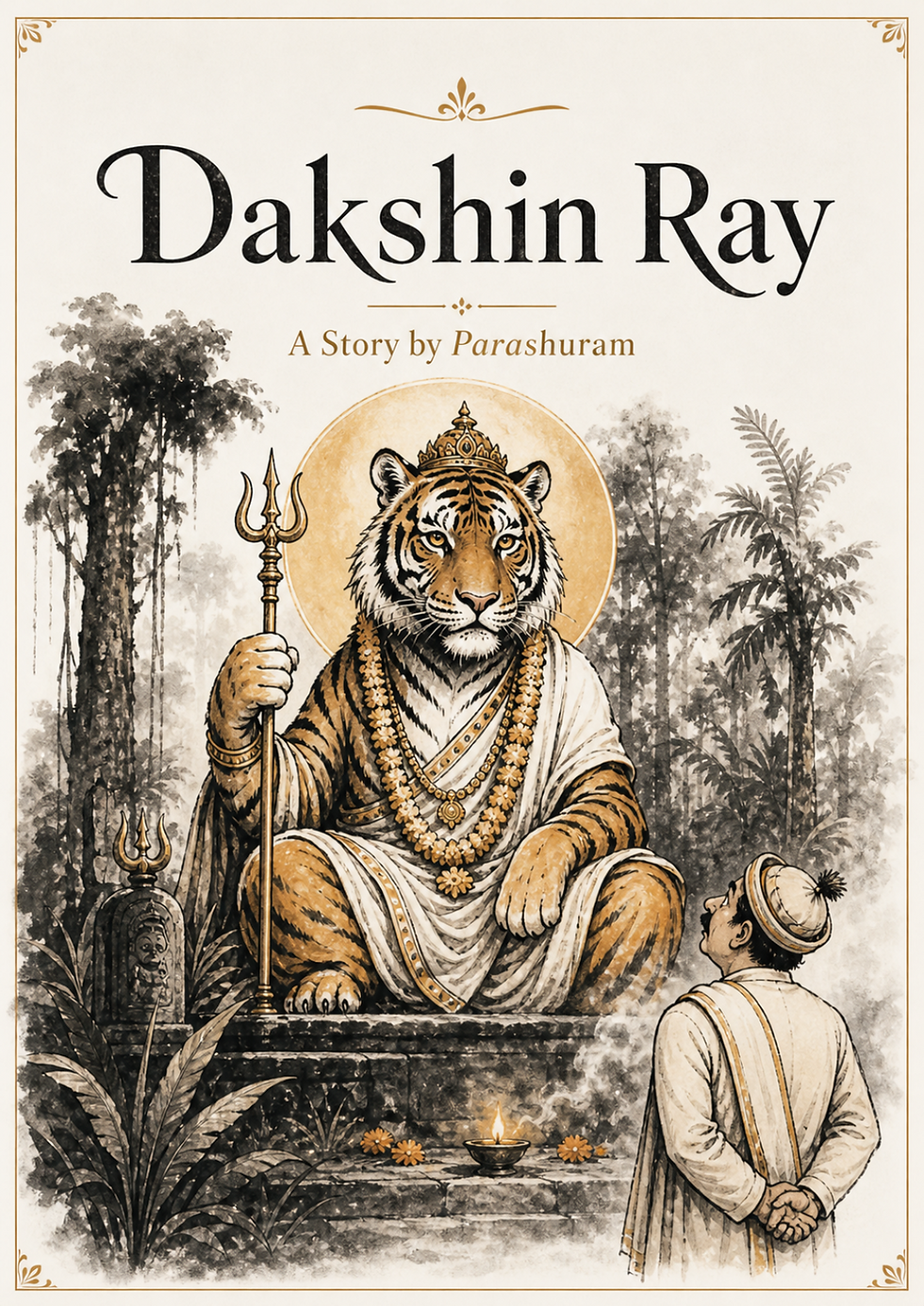
Dakshin Ray: A Humorous Literary Comic Adaptation is a bilingual visual storytelling work based on the classic Bengali satirical tale “Dakshin Ray” by Rajshekhar Basu, better known by his pen name Parashuram. The work presents the story through a series of premium, minimalist, 16:9 comic-style panels in English and Hindi, combining early twentieth-century Indian literary humour with elegant sepia-toned visual narration.
The adaptation follows the comic rise and fall of Bakulal Dutta, a clerk-turned-wealthy aspirant whose greed, political ambition and misplaced devotion lead him into the strange world of Baba Dakshin Ray, the legendary tiger-deity of the Sundarbans. Through drawing-room adda, colonial bureaucracy, political vanity, folk belief, supernatural satire and absurd transformation, the story becomes a sharp yet playful commentary on ego, opportunism, power-seeking and human foolishness.
This work includes translated narrative material, comic-page visualisations, author-background panels and contextual literary framing. It aims to make Parashuram’s humour accessible to contemporary readers while retaining the flavour of early twentieth-century Bengali comic prose. The visual style uses vintage Indian illustration, sepia ink-wash aesthetics, decorative panel borders, readable captions, and understated humour suitable for literary education, cultural archiving, digital humanities, storytelling, and public engagement.
The project was developed with extensive use of generative AI tools for translation, adaptation, visual design and comic-page creation, under human direction, selection, editing and literary framing by the creator. It is intended as an educational and creative reinterpretation, not a replacement for the original literary text.
Subjects: Literature; Bengali Literature; Indian Humour; Satire; Translation Studies; Literary Adaptation; Public Domain Literature; AI-assisted Creative Writing; Digital Humanities; South Asian Cultural Heritage.
Keywords: Rajshekhar Basu; Parashuram; Dakshin Ray; Bengali humour; Indian satire; literary adaptation; English translation; Hindi translation; public domain; AI-assisted writing; Kallol Saha; Development Connects; open access; Zenodo DOI; Creative Commons.
Title: Dakshin Ray: A Contemporary English Humour Adaptation
Subtitle / note: Based on the public-domain Bengali story by Rajshekhar Basu / Parashuram. Adapted, transformed and edited by Kallol Saha with AI-assisted drafting support.
Author note: “This is not a verbatim translation. It is a contemporary literary adaptation intended to preserve the comic spirit of the original while making it accessible to modern English/Hindi readers.”License: Creative Commons Attribution 4.0 International (CC BY 4.0)
AI Assistance Note:
“This story was developed with the assistance of AI tools for drafting, translation support, structure, language refinement, and visual concept development. Final selection, editing, interpretation, and publication responsibility remain with the author.”
Digital Object identification: 10.5281/zenodo.19997223
Kallol Saha. Dakshin Ray: A Humorous Literary Comic Adaptation. Development Connects, 2026. AI-assisted bilingual visual storytelling adaptation based on the classic Bengali satirical tale by Rajshekhar Basu / Parashuram.


Comments