


Science 4 Society: The Top 10 STEM News, April 2026

Ten Promising research and innovation for a better tomorrow
Science and technology news this week shows a clear global pattern: innovation is moving closer to real human use. From brain chips and artificial neurons to mRNA delivery, AI reasoning, quantum batteries, engineered bacteria and adaptive materials, the stories below show how Science, Technology, Engineering and Mathematics can improve healthcare, reduce energy use, strengthen research, and create more humane tools for society.
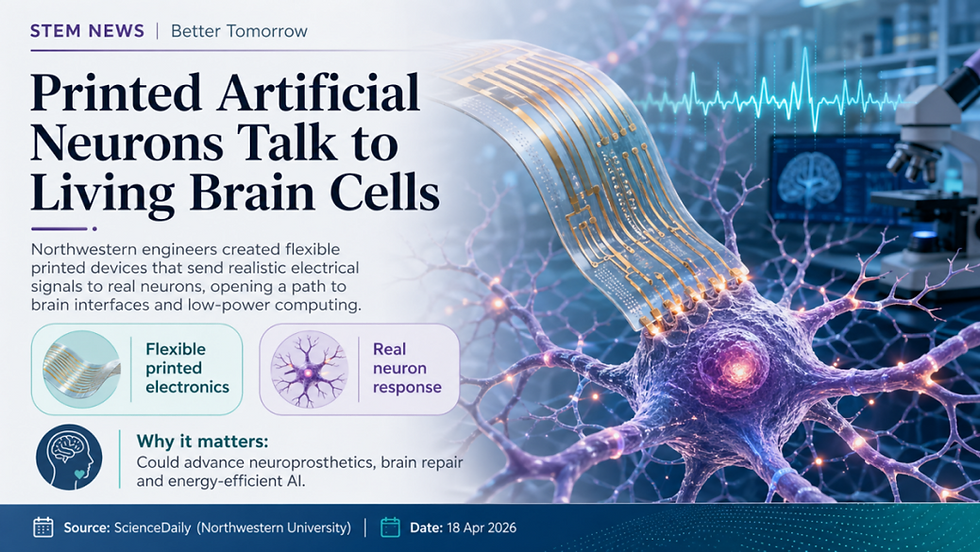
1. Printed artificial neurons talk to living brain cells
Northwestern University engineers have created flexible printed artificial neurons that can send realistic electrical signals to real brain cells. The breakthrough matters because future brain–machine interfaces may need devices that are soft, low-cost, printable and biologically compatible. In simple terms, this means electronics may one day communicate with the nervous system in a more natural way. The possible social impact is large: better neuroprosthetics, improved rehabilitation after brain or nerve injury, and new low-power computing inspired by the brain. This research was reported by ScienceDaily on 18 April 2026.
2. Brain-like chip could cut AI energy use by 70%
Researchers at the University of Cambridge developed a nanoelectronic device using modified hafnium oxide that can process and store information together, similar to how neurons work. Conventional computers waste energy by moving data repeatedly between memory and processor; this design could reduce that burden and potentially cut energy use by up to 70%. For society, this is important because AI is becoming part of education, health, agriculture, business and governance, but its energy demand is rising. More efficient chips could make AI cheaper, greener and more accessible to smaller institutions and developing regions. ScienceDaily reported the story on 23 April 2026.

3. AI discovers new physics in dusty plasma
A research team combined a neural network with precise 3D particle tracking to study dusty plasma, a complex fourth state of matter. The AI model identified hidden interaction laws and achieved more than 99% accuracy in capturing complex particle behaviour. The deeper importance is that AI is no longer only a tool for sorting data; it may help scientists discover new physical rules. In easy language, machines may help researchers see patterns that humans miss. This can improve future work in physics, engineering, materials science, plasma systems and advanced manufacturing. The finding was reported by ScienceDaily on 23 April 2026.

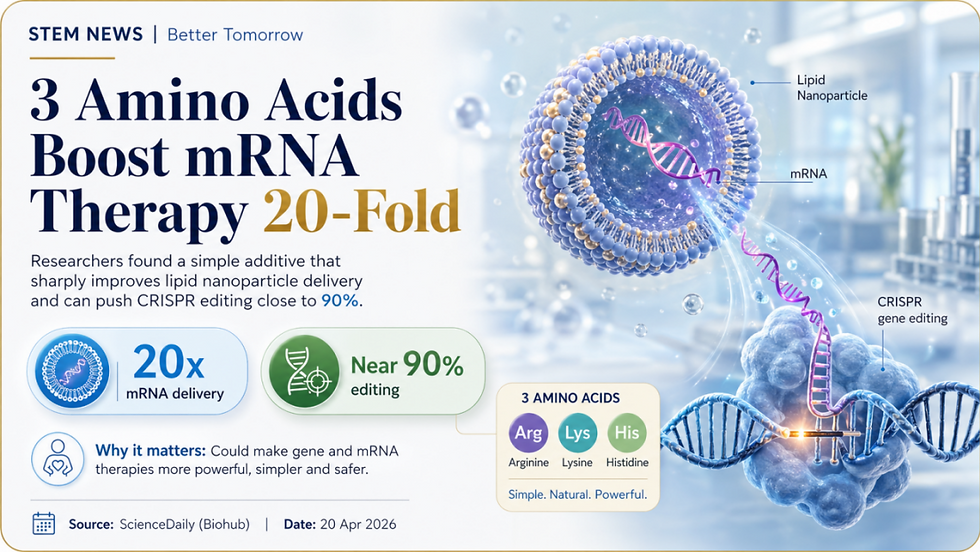
4. Three amino acids boost mRNA therapy 20-foldResearchers found that adding three common amino acids to lipid nanoparticles can improve mRNA delivery up to 20 times and push CRISPR gene-editing efficiency close to 90%. This is a major step because many gene and mRNA therapies depend not only on the medicine itself, but on whether it can enter the right cells efficiently. For ordinary people, this could mean more effective vaccines, better genetic medicines, and potentially lower doses with fewer side effects in future therapies. The innovation is promising because it improves delivery through a simple additive rather than a completely new drug platform. ScienceDaily reported this Biohub-linked research on 20 April 2026.
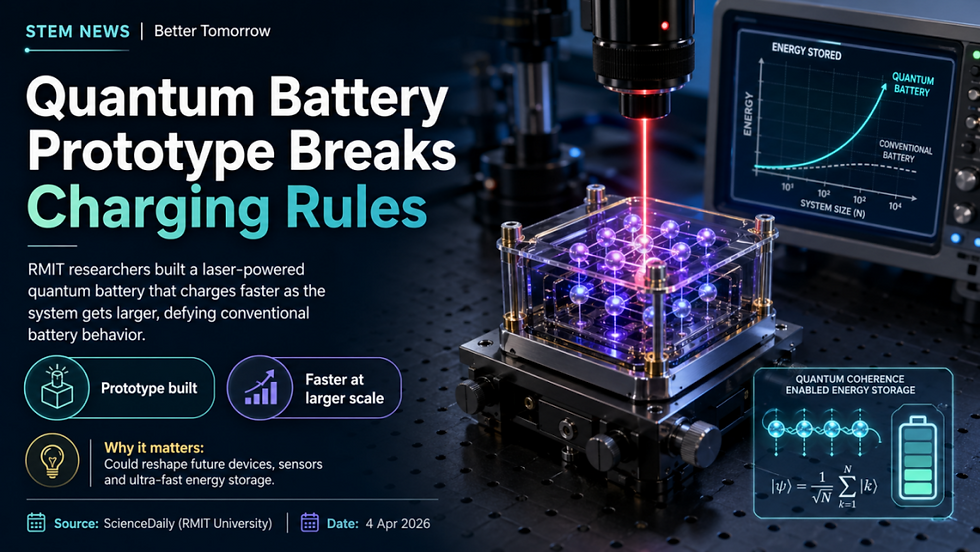
5. Quantum battery prototype breaks charging rulesRMIT University researchers built a small laser-powered quantum battery that can charge, store and release energy using quantum effects rather than conventional chemistry. The striking point is that the system may charge faster as it becomes larger, which is opposite to ordinary battery behaviour. This is still early-stage research, but the possible social impact is significant. If such systems mature, they could support ultra-fast energy storage for sensors, medical devices, communications, precision instruments and future computing hardware. ScienceDaily reported this quantum battery prototype on 4 April 2026.
6. New chipmaking tool targets AI’s monumental demandNature reported a breakthrough in advanced chipmaking technology using giant, nearly perfect mirrors and extreme ultraviolet lithography to print ever-smaller circuits. This matters because AI, medicine, research, manufacturing and public services all increasingly depend on high-performance semiconductors. Better lithography can help produce denser, faster and more energy-efficient chips. The social impact is indirect but powerful: better diagnostics, faster scientific modelling, improved digital infrastructure, and more capable tools for education and governance. At the same time, it reminds us that the AI revolution depends on deep engineering, precision optics, materials science and global semiconductor capacity. Nature published the report on 2 April 2026.

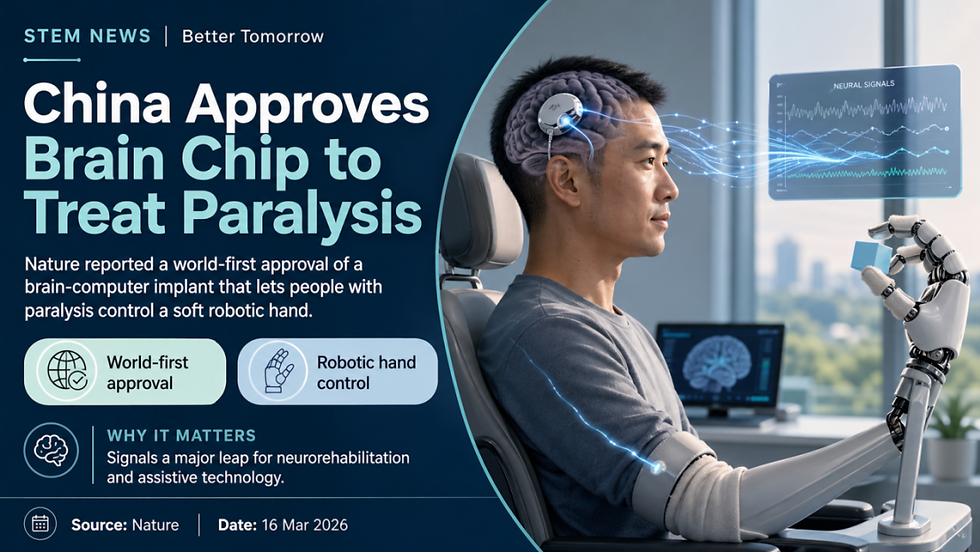
7. China approves brain chip to treat paralysisNature reported that China approved a brain-computer implant designed to help people with paralysis control a soft robotic hand. This was described as a world-first approval and signals a major movement from laboratory experimentation toward practical neurorehabilitation. In simple words, the technology reads brain signals and helps convert intention into movement through a robotic device. The possible impact for society is profound: people with spinal cord injury, stroke-related paralysis or severe motor disability may gain new forms of independence. It also raises important questions about safety, affordability, ethics and access. Nature reported the development on 16 March 2026.
8. Octopus-inspired material changes colour and textureStanford scientists created a shape-shifting material inspired by octopus skin that can change both colour and surface texture. This kind of biomimetic engineering shows how nature can guide advanced materials design. For society, the possible uses are wide: soft robots that adapt to surroundings, medical surfaces that change grip or texture, smart clothing, safer prosthetics, adaptive displays and responsive design in industrial tools. The key message is simple: future materials may not remain passive. They may sense, respond and physically transform according to need. ScienceDaily reported the Stanford research on 31 March 2026.

9. AI models show basic real-world understandingBrown University researchers found that AI language models can mathematically distinguish between common, impossible and nonsensical events. This is important because society needs AI systems that are not only fluent in language, but also safer, more reliable and more grounded in reality. For daily users, it means future AI tools may become better at identifying absurd claims, impossible situations, or misleading reasoning. This can improve education, decision support, governance, legal drafting, scientific assistance and public communication. The finding does not mean AI has human understanding, but it suggests that some basic model-based reasoning is emerging. Brown University reported the study on 22 April 2026.

10. Engineered bacteria aim to treat metabolic diseaseResearchers at the National University of Singapore engineered beneficial gut bacteria to work as programmable therapeutics that may help restore balance across the gut, liver and brain. This is promising because metabolic diseases are complex and often involve many body systems at once. Instead of only treating symptoms, engineered bacteria may one day deliver targeted biological effects from within the gut. For society, this could lead to lower-cost, more personalized treatments for chronic metabolic conditions, especially where long-term medicine access is difficult. MedicalXpress reported the NUS breakthrough on 28 April 2026.

Together, these ten stories show that STEM is becoming more human-centred. The most important breakthroughs are not only about faster machines or smarter algorithms; they are about restoring movement, improving treatment, reducing energy use, strengthening scientific discovery, and designing materials and systems that respond to real human needs. This is the promise of Science 4 Society: research that does not remain inside laboratories, but gradually becomes a tool for dignity, access, health, resilience and a better tomorrow.


Comments