


Tales From Navratangarh

The air in the Gwalior prison was thick with the must of centuries and the quiet despair of fallen kings. For twelve long years, Maharaja Durjan Shah, the forty-ninth Nagvanshi ruler of the Jharkhand wilds, had stared at its stone walls. He had been brought here in chains, his kingdom of Khukhragarh overrun by the armies of the Mughal Subedar Ibrahim Khan, his dream of independence crushed under the imperial heel. The charge? Withholding tribute. The real reason, as Durjan Shah knew deep in his bones, was the diamond.

The diamonds of the Sankh and Koel rivers were not mere gems; they were whispers of light, born from the womb of the earth, carrying the power to make and break kings. Durjan Shah, whose ancestors had ruled the Chotanagpur plateau for two thousand years, had inherited not just a throne but an ancient, almost mystical knowledge of these stones. He could feel their flaws as a musician feels a discordant note. And it was this gift, locked away with him in the fortress prison, that would become his key to freedom.
One humid afternoon, the jailer, a man whose face was as grey and unyielding as the stone he guarded, shuffled into Durjan Shah’s cell. His eyes, usually devoid of any emotion, held a flicker of curiosity. “Raja,” he grunted, the title slipping out as if it were a foreign word on his tongue, “you are to come with me. A messenger from the Emperor Jahangir himself is here.”
Durjan Shah rose slowly, his joints protesting. He smoothed his matted beard and followed, his heart a frantic drum against his ribs. In the fortress’s main hall, a dusty ray of sunlight fell upon a velvet cloth. On it lay two diamonds. One, large and brilliant, caught the light and threw it back in a thousand fiery sparks. The other was smaller, seemingly dull and ordinary.
The Mughal messenger, a peacock-proud nobleman named Mirza Ali Beg, gestured towards them with a sneer. “The Emperor’s own jewelers have tested these stones. They declare this,” he pointed to the large diamond, “to be the purest, a gift worthy for the Shah of Persia. This other,” he waved dismissively at the smaller one, “is flawed, fit only for the bazaar. But the Emperor, in his infinite wisdom, remembers a tale of your… peculiar skill. He wishes for a second opinion. Fail, and your chains will be forged anew, perhaps heavier than before.”
Durjan Shah stepped closer, his eyes not on the stones, but on the light within them. He didn’t see the sparkle; he saw the structure, the subtle shift in clarity. He looked at the large diamond, the one the experts had hailed as perfect. A faint, almost imperceptible cloud, a tiny fracture line running parallel to a facet, revealed its secret. It was a stone of show, beautiful to the untrained eye, but brittle at its core. Then he looked at the smaller one. Its surface was calm, its depths undisturbed. It was a stone of substance, of quiet, enduring strength.
He straightened his back, the posture of a king returning to a body that had forgotten it. “The jewelers of the Emperor are like men who see the reflection of the moon in a puddle and call it the moon itself,” he said, his voice low and steady. “This,” he pointed to the large diamond, “is flawed. It will shatter under pressure. And this,” he touched the smaller one, “is flawless.”
A gasp ran through the hall. Mirza Ali Beg’s face purpled with rage. “You dare mock the Emperor’s chosen men? You jungle-dweller! Prove it!”
Durjan Shah looked around the hall and his eyes fell upon a sturdy ram tied in the courtyard, its horns spiralling with power. “Bring that ram,” he commanded. “And bring another, equally strong.”
The scene that followed became legend. Durjan Shah took the two diamonds and, with a piece of sinew, fastened the large, “perfect” stone to the horn of the first ram, and the smaller, “flawed” one to the horn of the second. The animals were goaded into a fight. They clashed with a thunderous crack of bone and horn. When they were pulled apart, the first ram’s horn was shattered, and the magnificent diamond lay in pieces on the bloodied earth. The second ram’s horn was intact, and the smaller diamond remained in its place, gleaming with a quiet, victorious light.
News of this miracle reached the ears of Emperor Jahangir in his Agra court. Amused and impressed, he ordered Durjan Shah to be brought before him. The emperor, a connoisseur of art, jewels, and rare skills, looked upon the wild-eyed king from the forests of the east. He saw not a captive, but an artist of the earth.
Jahangir granted him an audience. “Your knowledge is a gift from God,” the Emperor said. “It shall not be wasted in a dungeon. I restore your kingdom to you. But tell me, Raja Durjan Shah, what boon do you seek?”
Durjan Shah bowed his head, not in subservience, but in gratitude. “Huzoor,” he said, his voice thick with the memory of his homeland, “my only wish is to return to my ancestors’ land. To build a new capital, one that reflects the peace and wisdom you have shown today. A place of nine gems—Navratan—to honour the nine priceless things in life: wisdom, courage, and the blessings of the gods.”
Jahangir was pleased. He conferred upon him the title of ‘Shah’ and sent him back to his beloved Chotanagpur, a free man.
The Architect and the Mendicant

Back in his homeland, the air thick with the scent of sal and mahua flowers, Durjan Shah was not just a king returning; he was a man reborn. The Mughal architecture he had seen in Agra and Delhi—the grand arches, the intricate jaali work, the perfect symmetry of the gardens—had seared itself into his imagination. He wanted to fuse that grandeur with the rugged soul of his own people’s art.
He summoned his chief architect, a man named Gangu, whose family had raised palaces and temples for generations, their craft passed down from father to son. Gangu was not just a builder; he was a sthapati, a man who understood the sacred geometry of the Vedas. With him was his daughter, Chhaya.
Chhaya was a wisp of a girl, her eyes large and curious, always stained with the red powder of the stone being cut or the charcoal of the drawings. She had no formal place in the councils of men, but her father rarely made a decision without her. She had an uncanny ability to visualize space, to see how light would fall on a carved lotus, how water would flow through an aqueduct.
“Maharaj,” Gangu said, unrolling a palm-leaf scroll on the forest floor. “The fort of Khukhragarh served us, but it is vulnerable. We need a place where the hills themselves are our walls. I have scouted a ridge near the Sankh, a place called Doisagarh. It is guarded by dense forests on three sides and a deep gorge on the fourth. It is perfect.”
Durjan Shah listened, his gaze lost in the distance. “Gangu, it must not just be a fortress. It must be a statement. The Mughals build with sandstone and marble. We will build with the very stone of this plateau. But I want the world to know that a Nagvanshi king has seen the world and brought back its finest essence. I want temples with spires like the ones in Odisha, reaching for the sun. I want palaces with the grace of Rajputana. But at its heart, it must be our own. The home of the Nagas.”
It was Chhaya who spoke, her voice soft but clear. “Maharaj, like a diamond, the fort must have many facets. A face for the gods, a face for the people, a face for the king, and a secret heart that only the builders know.”
Gangu looked at his daughter, a mixture of pride and fear in his eyes. But Durjan Shah smiled. It was the first genuine smile since his return. “Yes. Like a diamond. A Navratangarh. You understand.”
While Gangu and his thousands of laborers—tribal men and women who could move mountains of rock with breathtaking skill—began their work, another figure arrived at the nascent capital. He was a wandering Nath Yogi, a man named Matsyendranath, his body smeared with ash, his matted locks piled high on his head. He was no ordinary ascetic. He was a trader of ideas, a philosopher, and a master of esoteric rituals.
He sought an audience with the king. “Maharaj,” he said, his voice raspy from years of silence, “you build walls of stone. But a kingdom is not protected by walls alone. It is protected by the will of the gods. Let me consecrate this land. Let me build a math here, a monastery, so that the spiritual energy of your reign is as strong as its military might.”
Durjan Shah, ever conscious of the divine, agreed. He saw in this yogi the same intensity he saw in his own heart. The yogi would oversee the building of the temples, ensuring the idols were placed at points of cosmic energy, his followers chanting mantras to purify every brick laid.
The Secret Beneath the Stones
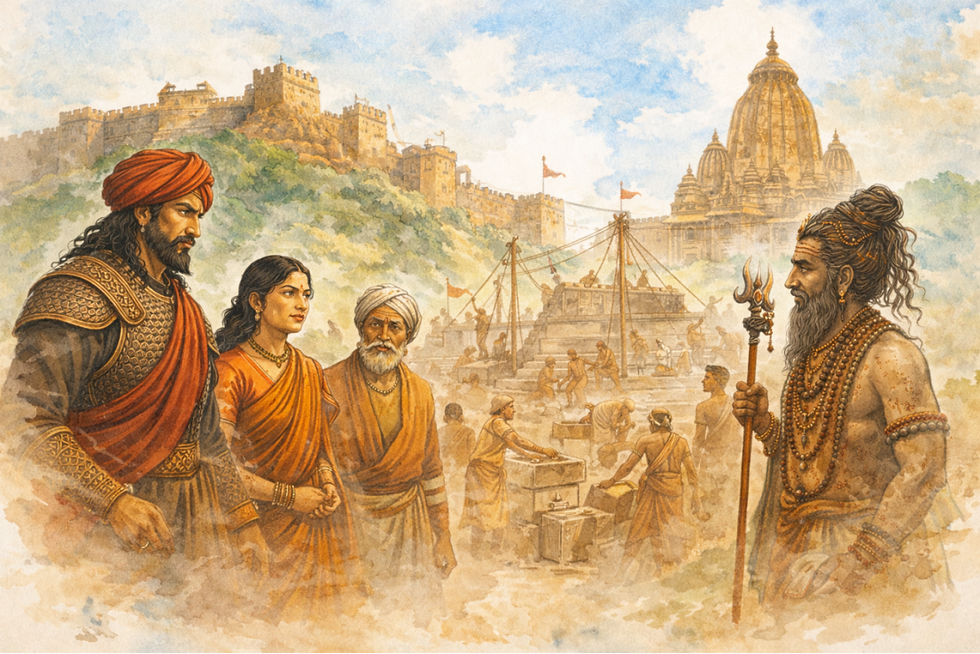
Years passed. The sound of hammers on chisels was the constant music of Doisagarh. The five-storeyed royal palace began to rise, each floor with its nine rooms, catching the breeze and the views of the endless forests. The Rani’s palace, a more delicate structure, was built close by, with a private bawli, a stepwell, where the queen could bathe in cool, shaded waters.
One evening, as the sun bled orange and red behind the distant hills, Chhaya approached her father with a rolled-up cloth. Inside was a meticulous drawing, far more detailed than any of the palm-leaf sketches. It showed the main palace, but beneath it, a labyrinth of chambers, corridors, and a long, straight tunnel leading out from under the walls, emerging at a hidden grove miles away.
“What is this, Chhaya?” Gangu whispered, his voice filled with awe and terror. “This is… building for ghosts.”
“No, Baba,” she said, her eyes serious. “This is for the Maharaj. The Mughals released him once. They may not be so kind again. Or another enemy may come. A king needs a place to safeguard not just his life, but his soul—his treasury, his family, the sacred texts. And if the unthinkable happens, he needs a way to live and fight another day. The tunnel will lead to Palkot, our subsidiary capital.”
She had listened to the warriors’ talk, to the king’s quiet worries, to the yogi’s mutterings about the impermanence of power. She had poured all that fear and foresight into her design. It was a masterstroke of engineering—a hidden, multi-storeyed underground palace with secret chambers, a treasury, and a tunnel that was its own kind of diamond, flawless and unbreakable in its purpose.
Gangu took the plan to the king. Durjan Shah studied it in silence for a long time. He looked at Chhaya, who stood trembling behind her father. “You have seen the flaw in the future, child,” he said softly, “and you have given us the perfect diamond to protect against it.” He ordered the work to begin in the utmost secrecy, by a special team of laborers who were sworn to silence.
The Joy and the Omen
In the year 1639, the great fort was complete. The main temple of Jagannath, built by the royal preceptor Harinath, stood facing the east, its spire a miniature replica of the one at Puri. The deities of Jagannath, Balabhadra, and Subhadra were installed with great pomp and ceremony. The king, his family, and the entire populace celebrated for days. The palace, with its grand darbar hall, its water reservoirs, its watchtowers, was a sight to behold. It was truly Navratangarh, the abode of nine gems.
But even in the midst of such joy, a shadow fell. As the royal family prepared to formally shift their residence from the old palace to the new, the chief priest, a venerable old Brahmin named Visharad, performed a vastu puja. He walked through every room, chanting mantras and sprinkling holy water. When he came out, his face was ashen.
He asked for a private audience with the king. “Maharaj,” he said, his voice trembling, “the fort is magnificent. A triumph of art and will. But the stars… the stars do not favour it as a permanent abode. The planetary alignment at the time the foundation stone was laid… there is a dosha, a flaw. It is a place of power, yes. A place of refuge. But for a king to live out his days here, in peace… the omens are not good.”
Durjan Shah’s joy was punctured. He remembered Chhaya’s secret tunnel, built for escape. Was the fort destined to be a place of flight, not of lasting peace? “What must we do, Guruji?” he asked.
“The site is not unlucky for everyone. It is sacred to the gods. It will forever be a place of worship. But for the seat of power… you may have to leave it sooner than you wish. Perhaps your successor, or his successor,” the priest said, his gaze distant.
Durjan Shah accepted the words with the same equanimity with which he had accepted his imprisonment. He had built his dream, his diamond fortress. Whether he lived in it for a decade or a day, it was a testament to his spirit, a gift to his lineage. He understood that some things are built to last forever in legend, even if they are fleeting in reality.
The Last King of Navratangarh
Decades later, the prophecy came to pass. King Raghunath Shah, a poet and a devout Vaishnava, sat in his father’s palace, composing beautiful verses in the Nagpuri language, praising Lord Krishna. He had added to the grandeur of Navratangarh, building more temples, including a second one to Jagannath in 1683. Under his patronage, the fusion of cultures that Durjan Shah had envisioned—the Odisha-style spires, the Rajput-inspired palaces, the local tribal motifs carved into stone—had reached its zenith.
But trouble was brewing. The Mughal Empire under Aurangzeb was expanding its reach. To the west, the ambitious Chero king Medini Ray of Palamu had grown powerful. He cast envious eyes on the wealth and prestige of the Nagvanshi kingdom.
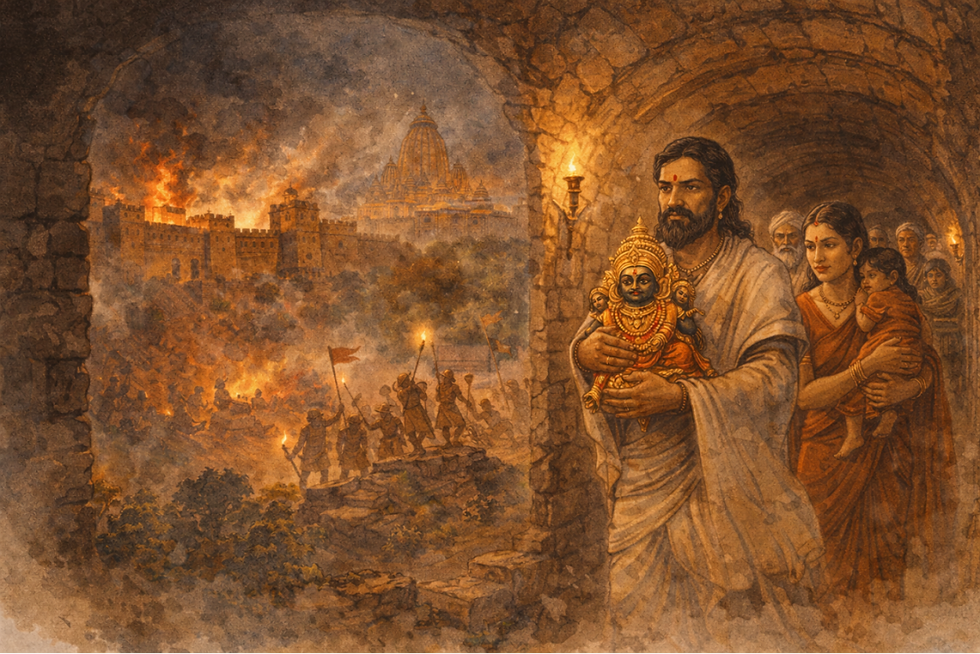
One moonless night, the alert came. Medini Ray’s army had bypassed the main passes and was approaching Navratangarh. Raghunath Shah was no warrior like his forefathers. He was a man of letters, a philosopher-king. He knew he could not win a direct confrontation. He looked out from his five-storeyed palace towards the direction of the secret tunnel, the one Chhaya had designed long ago, its entrance now overgrown with vines and known only to the royal family and their most trusted aides.
He made a choice. To save his family, his treasury, and the soul of his kingdom, he would have to abandon the physical embodiment of his grandfather’s dream.
As Medini Ray’s forces breached the outer walls, a silent procession moved through the underground passage. Raghunath Shah, carrying the sacred idols from his shrine, led his family into the dark, towards Palkot. Behind them, Navratangarh was sacked. Medini Ray, in a symbolic gesture of utter conquest, tore down the magnificent main gate of the fort and carried it off to Palamu, where it was installed as a trophy, known forever after as the ‘Nagpuri Gate’.
In the days that followed, the remaining inhabitants, the mullahs and caretakers, slowly drifted away. The royal priests, the guards, the merchants—they all left for the new capital at Palkot. The silence returned to Navratangarh, deeper than it had ever been before. The forests began their slow, gentle reclamation.
Chhaya, now a very old woman, was one of the last to leave. She walked through the deserted darbar hall, her footsteps echoing in the emptiness. She ran her wrinkled hand over a pillar, feeling the cool stone, the life she and her father had carved into it. She saw not ruins, but the glory of the day it was built, the hope in the king’s eyes, the sweat of the laborers, the chants of the yogi. She had poured her soul into its secret heart, and that heart would beat on, hidden beneath the earth, long after she was gone.
She walked to the edge of the ridge and looked back. The setting sun painted the abandoned palaces and temples in hues of gold and crimson. It looked less like a ghost town and more like a city of the gods, descended to rest upon the Chotanagpur hills.


Comments