


Lok Sabha’s Delimitation-Women’s Quota Debate Ends in a Political Standoff

The Lok Sabha on Friday, April 17, 2026, turned into the centre of one of the most consequential constitutional debates in recent years, as Members discussed a package of three linked measures: the Constitution (131st Amendment) Bill, 2026, the Delimitation Bill, 2026, and the Union Territories Laws (Amendment) Bill, 2026. The government argued that the package was meant to operationalise one-third reservation for women in the Lok Sabha and State Assemblies before the 2029 general election. But the core Constitution amendment failed in the House, with 298 MPs voting in favour and 230 against, falling short of the required two-thirds majority of members present and voting. Since the three bills were described as intrinsically linked, the remaining two were not taken up for a vote.
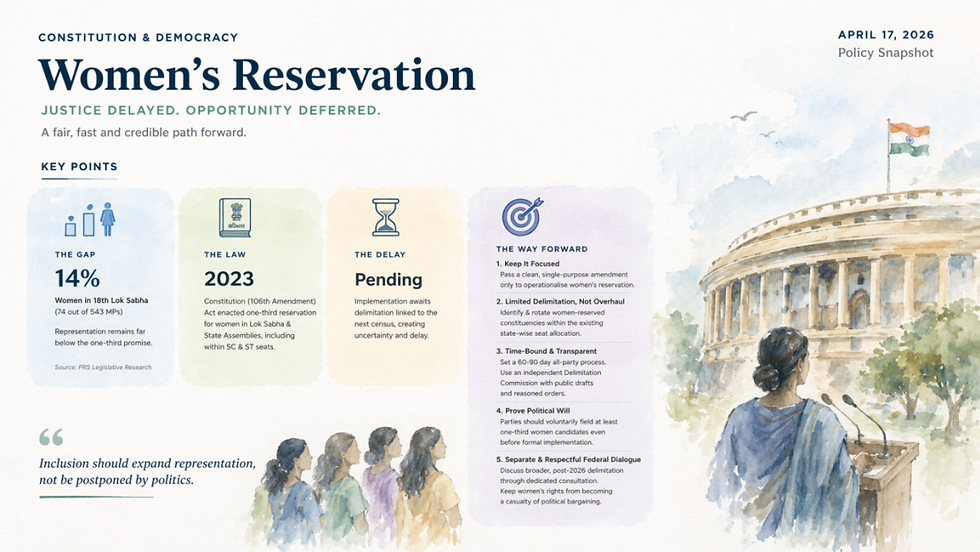
At the heart of the debate was a real political contradiction. India has already passed the Constitution (106th Amendment) Act, 2023, often called the Nari Shakti Vandan framework, which provides for nearly one-third reservation for women in the Lok Sabha, State Assemblies, and the Delhi Assembly, including within SC and ST reserved seats. However, that law made implementation contingent on a fresh delimitation after the first census conducted after the Act came into force. The 2026 amendment package sought to remove that wait by enabling a new delimitation on the basis of the latest published census and by modifying the constitutional scheme so that reservation could start earlier. The Statement of Objects and Reasons itself acknowledged that waiting for the next census and the delimitation thereafter would delay women’s effective participation in legislatures.
The key provisions of the 2026 package were politically explosive because they went beyond women’s reservation alone. According to PRS Legislative Research, the bills proposed restoring the principle that Lok Sabha seats across states should broadly reflect population, allowing Parliament by law to decide when delimitation would occur and which census would be used, and raising the maximum size of the Lok Sabha from 550 to 850 members, with up to 815 from states and 35 from Union Territories. PRS also notes that the accompanying Delimitation Bill would effectively allow the next exercise to be based on the latest published census at the time the Delimitation Commission is formed, which in present circumstances implies the 2011 Census.
That is why the discussion rapidly widened from women’s representation to federal balance. PRS estimates show that under a population-linked readjustment, the relative distribution of seats among states could shift substantially. In one illustrative scenario cited by PRS, Tamil Nadu could fall from 39 seats to 32 and Kerala from 20 to 15 if the overall House size were unchanged, while Uttar Pradesh could rise from 80 to 89, Bihar from 40 to 46, and Rajasthan from 25 to 30. Even with a larger House, the political anxiety in southern and slower-population-growth states is not imaginary. The debate therefore became not just about whether India wants more women in legislatures, but about whether that objective should be tied to a potentially contentious redistribution of parliamentary power.
The numerical context makes the urgency of the women’s quota argument easy to understand. In the 18th Lok Sabha, women account for only 14% of MPs, which PRS says is not a significant improvement over 2019. Earlier PRS data had placed women’s representation in the Lok Sabha at around 15%, still far below the one-third mark proposed in law and below many countries with stronger gender balance in legislatures. This gap is particularly striking because India has far stronger women’s participation at the grassroots level: the Union government said in 2025 that the country has about 14.5 lakh elected women representatives in Panchayati Raj Institutions, around 46% of the total, with 21 states providing 50% reservation for women in PRIs. In other words, India has already shown at the local level that higher female representation is administratively feasible and politically sustainable.
Inside the Lok Sabha, the government framed the bills as a historic corrective. News On Air reported that ministers argued women’s reservation should not be seen as charity but as rightful recognition after decades of underrepresentation. The opposition, meanwhile, attacked the package as a constitutional and political redesign masquerading as women’s empowerment. According to News On Air and multiple news reports, Rahul Gandhi argued the move was less a women’s empowerment bill and more an attempt to redraw the electoral map, while opposition leaders warned that linking reservation to delimitation and census sequencing could sideline other representational questions, including the political weight of backward classes and states with successful population stabilisation.
My view is this: women’s reservation is both just and overdue, but constitutional justice must not be delivered through a design that creates a second injustice. India should move firmly to guarantee one-third representation for women in Parliament and Assemblies, because 14–15% representation in the national legislature is too low for a democracy of this scale. But the country should not force women’s political inclusion to depend on a delimitation formula that many states fear will dilute their voice despite decades of better social development and population control. A wiser path would be to build cross-party consensus around women’s reservation first, with federal safeguards made explicit, and then undertake delimitation through a transparent, independently scrutinised framework. Women should not have to wait indefinitely, but nor should gender justice be made hostage to a North-South numbers conflict. In a mature republic, inclusion must expand representation, not reallocate distrust.


Comments