


Recharge to revive : The Case of Govindgarh
- Development Connects

- 50 minutes ago
- 9 min read

Govindgarh’s Vanishing Groundwater: Crisis, Science, and Solutions
Govindgarh. The name itself doesn't scream crisis. It sits quietly in Jaipur district, part of Rajasthan’s semi-arid landscape, a place where the sun is harsh and rain is never quite enough. But beneath the surface, something alarming has been unfolding over the past few years. Govindgarh is not just water-stressed. It is, by every official measure, one of the most over-exploited blocks in the entire state. And the numbers tell a story that is impossible to ignore.
Let’s begin with the classification. The Central Ground Water Board, in its comprehensive 2024 report submitted to the Jal Shakti Ministry, confirmed that 16 blocks in Jaipur district have been categorised as “overexploited”. Govindgarh and neighbouring Jhotwara are at the epicentre, showing an alarming water table depletion of 25 metres between 2020 and 2023. Twenty-five metres in just three years. That is not a gradual decline. That is a freefall.

The CGWB report further stated that the district used 2.25 litres of groundwater against a recharge of just 1 litre in 2023. This is a deficit that compounds year after year. An alarming 99% of Jaipur’s total irrigated land—2.80 lakh hectares—relies entirely on groundwater. Within this, Govindgarh alone accounts for 40,000 hectares of irrigated land. Forty thousand hectares, all sucking water from the same depleting aquifers.
These blocks have undergone rapid urbanisation, leading to the overutilisation of water for the past 20 years. Moreover, the shift from traditional crops to water-intensive crops to meet the burgeoning demand has witnessed a rise in unregulated borewells. The CGWB report also highlighted that blocks like Jhotwara and Kotputli are now exclusively using groundwater for industrial purposes, often in violation of the Master Plan of Jaipur, 2025, which explicitly prohibits water-polluting industries within a 10-kilometre radius of natural water bodies. “On the contrary, the concerned bodies, including the RIICO, have granted permissions to industrial units within the stipulated distance, leading to the pollution of groundwater and surface water,” a PHED source said.

But data, however stark, often feels abstract. The real story of Govindgarh’s water crisis is written not in reports but in the daily lives of its people. In October 2025, the village of Hadota in Govindgarh block faced a complete water supply shutdown for three consecutive days. No water from taps, no alternative tanker arrangement. A damaged main pipeline, caused by construction work on National Highway 52, had cut off the entire village. Residents, especially women and the elderly, were forced to carry water from distant sources. Shanti Devi, a local resident, described the ordeal: “We sit from morning to evening waiting for water. Sending children to school and managing household work has become extremely difficult”. Despite repeated complaints, repair work did not begin for days.

This was not an isolated incident. In August 2025, residents of several colonies in Govindgarh town—Hanuman Sagar, Solanki Mohalla, Badi Guwari, and others—protested outside the PHED office. The reason? Tanks built under the Jal Jeevan Mission, meant to provide drinking water, had never been connected to the main supply lines. Infrastructure existed on paper, but on the ground, it was useless. In December 2025, the Nai Mohalla area received water that was muddy and foul-smelling. Residents demonstrated, pointing to leakages in pipelines near drains that had contaminated the supply. Local resident Kamal Bhanja stated that for several days, taps had been supplying dirty and smelly water, completely unfit for drinking. Women reported that contaminated water supply had become a daily problem, forcing them to spend extra money on tanker water.
What we are witnessing in Govindgarh is a crisis of both quantity and quality. The aquifers are being depleted at an alarming rate, and the water that does reach people’s homes is often unsafe. In nearly 50% of Jaipur district, groundwater has already gone below 40 metres from the ground level. The aquifers, deposited over thousands of years, are being disrupted beyond repair.

So, what can be done? The situation is dire, but it is not hopeless. Solutions exist, but they require a fundamental shift in how we think about water—not as an infinite resource, but as a finite, shared commons that must be managed with discipline and foresight.
Let’s begin with the most fundamental process of all: getting water back into the ground. In Govindgarh, where the water table has dropped by 25 metres, the aquifer is like a giant, empty sponge. The process of refilling it is called Managed Aquifer Recharge, and it is the cornerstone of any sustainable solution. The Central Ground Water Board has identified that for areas like Govindgarh, where groundwater levels are quite deep, traditional structures like check dams are not suitable. Instead, the most effective technology is the recharge shaft—a deep, borewell-like structure filled with gravel and filter media, designed to capture surface runoff during the monsoon and channel it directly into the aquifer. In November 2024, the Ground Water Department floated a tender for the construction of artificial recharge shafts specifically in Govindgarh, Jalsu, and Amer blocks. This is not a theoretical concept. It is an active, ongoing process.

But digging a shaft is only the first step. The process of selecting its location is just as important. This is where technology like Geographic Information Systems and Vertical Electrical Sounding comes in. Vertical Electrical Sounding is a geophysical technique that sends an electrical current into the ground to map the subsurface layers, identifying the depth of the water table and the type of aquifer material. It tells you exactly where the aquifer is most receptive to recharge, ensuring that every shaft is placed for maximum impact. The process is data-driven and scientific, not random.

Now, let’s talk about technology on the demand side, specifically for agriculture. The process here is about shifting from flooding fields to precision irrigation. The two primary technologies are drip and sprinkler irrigation. Drip irrigation delivers water directly to the root zone of a plant through a network of tubes and emitters, virtually eliminating evaporation and runoff. Sprinkler systems distribute water like rain, which is far more efficient than flood irrigation. Rajasthan has made micro-irrigation central to its water management strategy; since 2016, all new irrigation projects are being developed entirely on drip and sprinkler systems. The process here is not just about installing the hardware. It involves a systematic shift in farming practices, from crop selection to irrigation scheduling. Laser land leveling is another critical process technology that complements micro-irrigation. By leveling the field, you ensure uniform water distribution, further reducing waste. The process is a holistic package: laser leveling plus drip irrigation plus crop diversification equals maximum water savings.

The technology for the third critical sector, industry, is centred on a process called Zero Liquid Discharge. A Zero Liquid Discharge system treats industrial wastewater through a series of physical, chemical, and biological processes, ultimately recovering over 95% of the water for reuse within the factory. The leftover solids are evaporated or disposed of safely, ensuring that no polluted water is discharged into the environment. The Rajasthan government is now mandating Zero Liquid Discharge technology for industries, with a new scheme offering up to ₹150 crore in support. This is a game-changer. It moves industry from being part of the problem to being part of the solution.

But even the best technology is useless without the right process for monitoring and governance. This is where digital innovation comes into play. The Atal Bhujal Yojana, a central government scheme with a total outlay of ₹6,000 crore, is already implementing a process of community-led groundwater management in over 8,000 water-stressed gram panchayats. For Rajasthan, funds released under the scheme as of March 2025 stand at ₹489.50 crore. The process involves installing Digital Water Level Recorders, rain gauges, and water quality testing kits at the village level. This data is then used by the community to prepare annual Water Budgets and Water Security Plans. The process is transparent and participatory; all data is publicly disclosed and hosted on the Atal Jal Portal and Mobile App. This transforms groundwater management from a top-down, opaque government function into a transparent, data-driven, community-owned process.

Furthermore, innovators are taking this a step further. For instance, a patented smart water monitoring system called TAP@APP, developed by an IIT Kharagpur alumnus, uses IoT and AI capabilities to provide real-time water quality diagnostics and predictive alerts. The process here is about empowering villagers with real-time information, allowing them to make immediate decisions about their water use. It’s about moving from quarterly or annual data to minute-by-minute intelligence.

And the process isn’t just about hardware and software; it’s about people. The MARVI project, which stands for Managed Aquifer Recharge through Village-level Intervention, demonstrated a powerful process in Rajasthan and Gujarat. They trained local volunteers, called “Bhujal Jankaars” or “groundwater informed” volunteers. These are local farmers and community members who are trained to understand recharge and discharge patterns, monitor water levels, and become local champions of groundwater management. They become the critical link between the scientists, the government, and the farmers. The process is transdisciplinary, bringing together technical, social, and economic inputs to create solutions with wider ownership and longer-term sustainability.
Now, let’s talk about specific interventions and the budget required over the next five years. The path forward must address three critical sectors: drinking water, irrigation, and industrial use, each with its own set of interventions.

First, drinking water security must be treated as an immediate, non-negotiable priority. In villages like Hadota, the solution is painfully simple: connect the Jal Jeevan Mission tanks to the main supply lines, repair damaged pipelines promptly, and deploy water tankers as an immediate backup when supply fails. Community RO plants, powered by solar energy, can provide safe drinking water in areas where contamination is high. The formation of Jal Samitis—village water committees with 50% women representation—is essential to monitor supply, coordinate with the PHED, and manage local water infrastructure. These are not complex interventions. They are basic governance functions that have simply failed to materialise. The estimated cost for drinking water interventions—rooftop rainwater harvesting on 200 public buildings, 20 community RO plants, and completion of pending Jal Jeevan Mission infrastructure—is approximately ₹2.6 to 4.4 crore over five years.

Second, agriculture, which consumes the lion’s share of groundwater in Govindgarh, must undergo a rapid and decisive transformation. The 40,000 hectares under irrigation cannot continue to rely on water-intensive crops. The shift must be towards millets, pulses, and oilseeds—crops that require 30% to 70% less water than wheat or sugarcane. Drip and sprinkler irrigation systems, available with up to 80% government subsidy, can reduce water consumption by 40% to 50% per hectare. The estimated cost for agricultural interventions—drip irrigation on 15,000 hectares, sprinkler irrigation on 10,000 hectares, crop diversification incentives on 10,000 hectares, and laser land leveling on 5,000 hectares—is approximately ₹29.5 to 40.5 crore over five years.

Third, industrial water use must be brought under strict regulation. Industries that have been permitted within the 10-kilometre buffer zone of water bodies must either relocate or adopt Zero Liquid Discharge systems. Decentralised sewage treatment plants can treat wastewater for industrial reuse, reducing the pressure on freshwater aquifers. The estimated cost for industrial interventions—Zero Liquid Discharge systems for 10 industrial units and two Common Effluent Treatment Plants with Zero Liquid Discharge—is approximately ₹25 to 40 crore, largely industry-funded.
Fourth, supply-side interventions—recharge shafts, injection wells, and filtration ponds—are critical to replenish the depleted aquifer. The estimated cost for 250 recharge shafts, 50 injection wells, and 55 filtration ponds and renovated traditional water bodies is approximately ₹23 to 31 crore over five years.
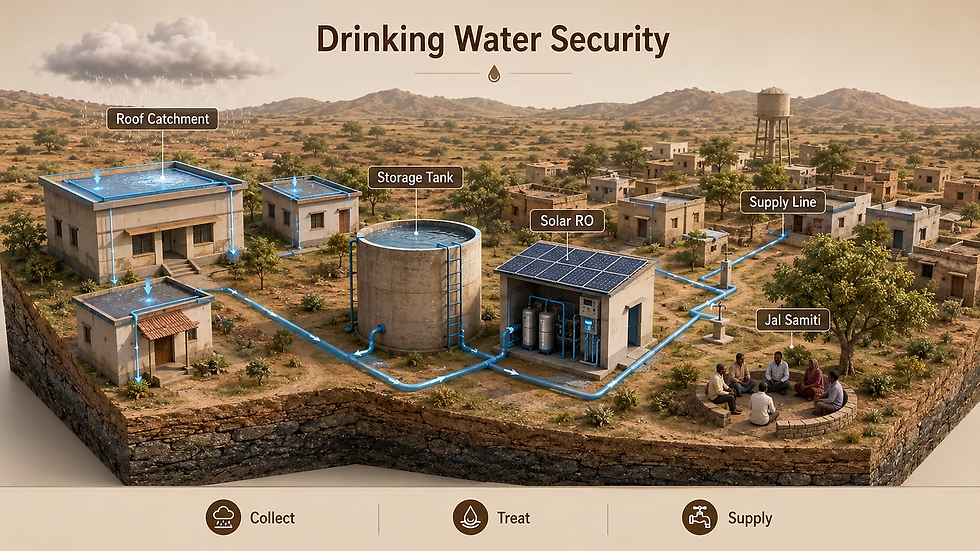
Finally, governance, monitoring, and capacity building must underpin everything. The estimated cost for a digital monitoring network with 50 piezometers, high-resolution aquifer mapping, and community training for Jal Samitis in all 47 Gram Panchayats is approximately ₹5 to 8 crore over five years.
The total estimated investment across all these interventions is approximately ₹86 to 130 crore over five years.
None of this will work without clear roles and responsibilities. Individuals can install rooftop rainwater harvesting systems, which can collect 50,000 to 100,000 litres of water per household every year. Communities, through their Gram Panchayats and Jal Samitis, must prepare annual village water budgets, maintain recharge structures, and enforce crop planning. The government must provide the policy framework, the subsidies, and the enforcement mechanisms that make all of this possible. Under the Jal Sanchay Jan Bhagidari 2.0 initiative, which aims to create one crore artificial recharge structures by May 2026, and the Atal Bhujal Yojana, which has a Budget Estimate of ₹1,780.40 crore for 2025-26, the funding mechanisms already exist. Sixty-five percent of MGNREGA funds in over-exploited blocks are already earmarked for water-related works; these must be utilised without delay.
Let me illustrate this with three specific village models from within Govindgarh block. In Hardota village, the primary challenge is a complete drinking water supply failure. Tanks built under the Jal Jeevan Mission remain disconnected from the main supply line. The solution is to connect these tanks immediately, install two community RO plants, and form a Village Water Committee. The estimated cost is approximately ₹22 lakh.
In Ghinoi village, the challenge is agricultural over-extraction. The solution involves drip irrigation on 200 hectares, crop diversification on 150 hectares, and recharge shafts in and around farmland. The estimated cost is approximately ₹105 lakh.

In Nangal-Govind village, the challenge is a combined quantity and quality crisis, with groundwater levels below 40 metres and contamination concerns. The solution involves recharge shafts, filtration ponds, a community RO plant with solar power, and rainwater harvesting on 100 households. The estimated cost is approximately ₹37 lakh.
These three models, totalling approximately ₹1.64 crore, demonstrate that solutions can be tailored to specific village contexts and implemented at scale.
The technology exists. The processes are proven. The challenge is no longer about what to do, but about summoning the collective will to implement this systematically and without delay. L K Sharma put it best: “The ideal situation is when one litre of groundwater is met with the same volume of recharge; otherwise, there will be a severe water crisis”. Govindgarh is already in that crisis. But it is also a place where solutions can be tested, refined, and scaled. If we can fix Govindgarh, we can fix a thousand other blocks across India that face the same fate.
The total estimated investment of ₹86 to 130 crore over five years is less than 0.5% of Rajasthan’s annual state budget. The cost of inaction—complete aquifer collapse, farmer distress, migration, and public health crisis—would be orders of magnitude higher. The question is not whether we have the technology or the resources. We do. The question is whether we have the will.


Comments