


Jharkhand on a Heap of Waste: An Uncomfortable Truth on World Environment Day
- Development Connects

- 2 days ago
- 6 min read

On World Environment Day, we often plant trees, make posters, deliver speeches and take pledges to protect nature. But from the towns and cities of Jharkhand, an uncomfortable question arises: can the environment be protected only by planting trees, while our urban areas push hundreds of tonnes of waste every day into land, water and air without scientific management?
The name Jharkhand immediately brings to mind forests, hills, waterfalls, rivers and mineral wealth. Yet the urban areas of this very Jharkhand are struggling with a serious solid waste crisis. This crisis is not only about dirty streets or foul-smelling drains. It is a crisis linked to land, water, human health, biodiversity and climate security.
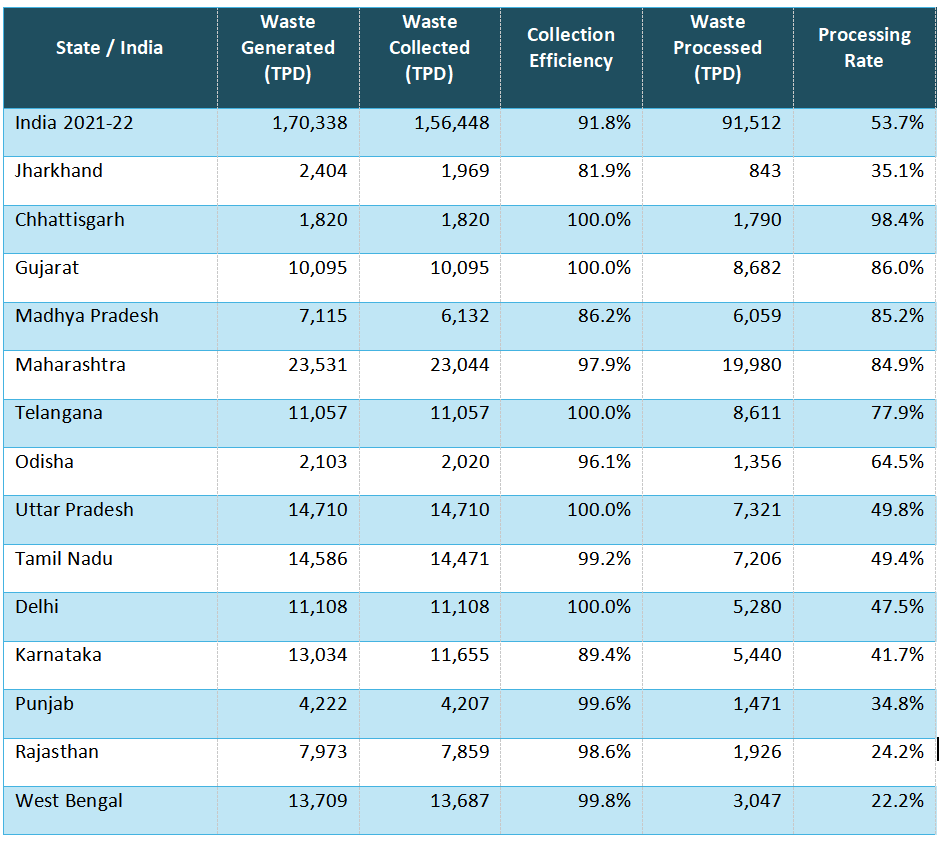
According to available government and audit-based data, in 2021–22, urban local bodies in Jharkhand generated about 2,404 tonnes of municipal solid waste per day. Of this, 1,969 tonnes per day was collected, but only 843 tonnes per day was processed. This means that about 435 tonnes of waste per day was not collected at all, and a total of around 1,561 tonnes per day either remained uncollected or stayed outside scientific processing.
When seen annually, the picture becomes even more worrying. Jharkhand’s urban areas generate about 8.77 lakh tonnes of waste every year. Of this, only about 3.08 lakh tonnes is processed, while nearly 5.70 lakh tonnes remains outside proper scientific management every year. This is not a small quantity. It is a serious comment on our urban governance, municipal capacity and environmental consciousness as a society.
Compared with many Indian states, Jharkhand’s performance appears weak. In 2021–22, India’s average municipal waste processing rate was about 54 percent, while Jharkhand’s processing rate was only about 35 percent. States such as Chhattisgarh, Gujarat, Madhya Pradesh, Maharashtra and Telangana performed much better in waste processing. Chhattisgarh recorded a processing rate of more than 98 percent, while Gujarat and Madhya Pradesh were around 85 percent. In comparison, Jharkhand still appears to be struggling with the basic challenges of collection, segregation and processing.
The problem is not only a shortage of machines or treatment plants. It is also a problem of governance, planning and behaviour. Audit findings showed that none of the 14 urban local bodies examined had prepared either short-term or long-term plans for solid waste management. A city without a waste management plan eventually begins to run on the logic of waste itself. In such a situation, waste does not merely travel from the dustbin to the dumping ground; it slowly begins to occupy our environmental future.
Source segregation in Jharkhand is also uneven and weak. In some places, it was as low as 1 percent, while some better-performing areas were also found. But the larger problem is that wet waste, dry waste, plastic, sanitary waste, e-waste and hazardous household waste often get mixed together. Once waste is mixed, its value declines. Wet waste cannot produce good compost, dry waste loses its recyclability, plastic mixed with food waste becomes dangerous for animals and birds, and sanitation workers are forced to handle unsafe mixed waste.
The first impact of this crisis falls on land. In 2021–22, about 930 tonnes of waste per day in Jharkhand went to landfills. Annually, this is about 3.39 lakh tonnes. With a moderate estimate, this amount of waste may create pressure on more than 4 hectares of new land every year. In five years, this pressure may reach 21 hectares, and in ten years, 42 hectares. This is not merely the space occupied by garbage heaps; it is land that could have become parks, public institutions, green areas, housing, community assets or urban forests.
The impact on water is even more serious. Open or poorly managed dumping sites generate leachate—a dark, polluted liquid that may contain organic pollutants, salts, pathogens and sometimes heavy metals. Under a moderate estimate, Jharkhand’s landfilled waste may create a risk of 50,000 to 85,000 kilolitres of polluted leachate or runoff every year. This is equivalent to 5 to 8.5 crore litres of polluted water. During the monsoon, this pollution can reach drains, ponds, small rivers and groundwater.
Many towns and settlements in Jharkhand still depend on groundwater, hand pumps, wells, ponds and small water sources. In such a situation, the mixing of waste with water is not merely an environmental issue; it is a question of drinking water safety. Plastic trapped in drains increases waterlogging. Wet waste becomes a breeding ground for mosquitoes and flies. Nutrient pollution in ponds creates foul smell, algal growth and stress on aquatic life.
The burden on human health falls most heavily on poor and vulnerable communities. Those who generate the least waste often suffer the worst effects of it. Families living near dumping sites, informal settlements, roadside workers, children, elderly people, women, sanitation workers and waste pickers stand in the first line of this crisis. Contaminated water increases the risk of diarrhoea, typhoid-like infections, skin diseases and parasitic infections. Open waste increases mosquitoes, flies and rats. Burning of waste can worsen respiratory diseases by releasing smoke, fine particles and toxic gases.
If only 10 percent of uncollected waste is openly burnt, it may mean about 43 tonnes per day or 15,900 tonnes per year of waste being burnt. This is only an estimate, but it is enough to show that burning waste is not a minor habit. It is an act that works against public health and air quality.
Biodiversity is also deeply affected by this waste crisis. Jharkhand is a state where towns, forests, farms, hills, streams and settlements often exist close to one another. When food waste is thrown in the open along with plastic, cows, goats, pigs, dogs and birds consume it. Plastic enters their stomachs. Plastic reaching drains and ponds affects fish, frogs and other aquatic organisms. If 10 percent of unprocessed waste is assumed to be plastic, about 57,000 tonnes of plastic-like material falls into the risk category every year in Jharkhand. If only 20 percent of this leaks into the open environment, it may create a plastic pollution risk of 11,000 to 12,000 tonnes per year.
The link with climate change is also direct. Wet waste lying in landfills produces methane, a greenhouse gas far more powerful than carbon dioxide. Under moderate assumptions, Jharkhand’s annual landfilled waste may create a long-term potential for 6,100 to 10,200 tonnes of methane generation. In carbon dioxide equivalent terms, this may become a climate liability of about 1.66 lakh to 2.77 lakh tonnes of CO₂e. This emission does not occur fully in a single year, but every year’s fresh waste adds a new climate liability.
There is also a positive side to the entire picture. Waste is not only a problem; it is also a resource. If about 50 percent of Jharkhand’s unprocessed waste is assumed to be wet or organic waste, nearly 2.85 lakh tonnes of organic waste every year can be converted into compost or biogas. This could generate up to about 70,000 tonnes of compost. Such compost could support urban gardens, parks, agricultural land, mine-spoil reclamation, plantation and soil-health programmes. Similarly, a large part of dry waste can become the basis for recycling, RDF, co-processing and local entrepreneurship.
Jharkhand must now stop treating waste management as merely a municipal cleaning activity. It is a matter of climate action, public health, water security, biodiversity protection and local economy. Every urban local body must prepare ward-wise waste management plans. Source segregation must be ensured from every household, market, hotel, institution, hospital and marriage hall. Decentralised composting and biomethanation must be promoted for wet waste, material recovery facilities for dry waste, and biomining of old dumping sites must be taken up as a campaign.
At the same time, waste pickers and informal recycling workers must not be kept outside the system; they must be brought to the centre of it. They are not the problem; they are an ignored strength of the solution. Women’s self-help groups, urban livelihood missions, youth entrepreneurs, recyclers and farmer producer organisations can also be linked with this new waste economy.
On World Environment Day, Jharkhand must move beyond photographs of plantation drives. The need now is for public city-level waste dashboards, ward-level competitions, civic discipline, both penalties and incentives, and above all, political and administrative will.
Jharkhand is proud of its forests. But no state can truly call itself green if its towns stand on heaps of garbage. Environmental protection may begin with forests, but it becomes complete only when it reaches the household dustbin, the neighbourhood drain, the town composting centre and the city dumping ground.
“Jharkhand on a heap of waste” should not become a permanent identity. It is a warning. If taken seriously, this warning can become the beginning of a new urban environmental movement for Jharkhand.
The real World Environment Day will arrive when every household segregates waste, every ward measures its waste, every urban local body turns waste into a resource, every dumping site begins to shrink, every sanitation worker is protected, and every citizen understands that the protection of nature can begin from the dustbin itself.


Comments