


One Day in Sundarban

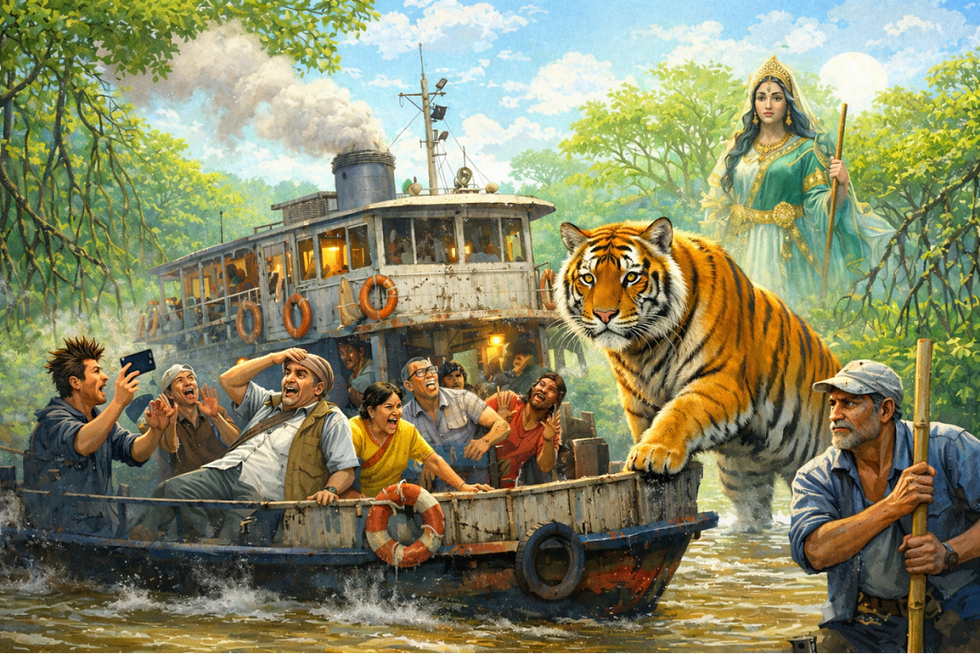
My name is Khoka. I am not a hero. I am not a vlogger. I am not even a particularly brave person, as my mother reminds me whenever a cockroach enters the kitchen and I climb onto the dining table like a monkey who has forgotten his caste. But I was there. On the Madhumati Dreamliner. And what I saw has permanently rearranged the furniture of my imagination.
First, you must understand the boat. The Madhumati Dreamliner was a name that required a visa to enter the country of truth. The boat itself was not a dream. It was not a liner. And Madhumati, if she existed, had clearly divorced it years ago. It coughed black smoke like an offended dragon who had been smoking since the Mahabharata. Its engine made a sound that can only be described as khach-khach-khurr-ghrrr—which, as any student of onomatopoeia will tell you, is the sound of an engine that has opinions about modern life and none of them are positive.
The boat had forty tourists. Why forty? Because forty is the number at which panic becomes statistically significant. It had three schoolteachers—which meant there were three people on board whose job it was to explain things, and who would therefore be completely useless in an actual emergency. It had two vloggers. And it had one man who claimed he could "smell tigers" the way some people claim to smell rain, by which I mean he was lying but believed his own lie with such sincerity that it almost became truth. I was there because my uncle, who makes decisions like a man trying to solve a Rubik's cube blindfolded, thought a Sundarbans trip would be "educational." Education, as I have since learned, is sometimes the process of discovering that you are smaller than everything that wants to eat you.
One of the vloggers—the one with hair that looked like it had been styled by a frightened hedgehog—stood at the front of the boat and pointed his phone at the river. "Bro," he announced to his phone, which was the only creature listening to him with any enthusiasm, "if tiger comes, I will get cinematic." The river was patient. The river was brown. The river was ancient. The river had seen empires rise and fall, cyclones come and go, and entire generations of vloggers try to extract content from its indifferent waters. The river did not respond. The river did not even blink, because rivers do not have eyelids, which is perhaps their greatest advantage over nervous humans.
The boatman, Bimal-da, stopped chewing paan. This was significant. Bimal-da had been chewing that particular piece of paan since before we left the jetty. It was, I believe, a relationship. The paan and Bimal-da had reached an understanding. They had shared silences. They had completed each other's sentences. When Bimal-da stopped chewing, it was like the earth stopping its rotation. "Stop recording," Bimal-da said. His voice was soft. It was the softness of a man who has seen things and would very much like not to see them again. The vlogger laughed. Laughing, as we would soon learn, was a category error of catastrophic proportions. "Why, bro? This is the moment!" Bimal-da looked at him with the infinite weariness of a man who had spent thirty years on these waters. "This," he said, pointing at the vlogger's phone, "is the moment you become a news headline. And I," he added, gesturing at himself, "become jobless. My wife becomes a widow. My son becomes a statistic. And my paan becomes a suicide note."
And then—out of the mangroves—stepped the tiger. I must describe this tiger properly, because description is the only weapon I have against the memory of it. He did not leap. He did not roar. He did not do any of the things that the National Geographic voiceover would approve of, the things that make you feel safe because they happen inside a television and not inside your actual breathing space. No. He walked. He walked like a landlord arriving to inspect the property. He walked like a distant relative who has come to stay for three weeks and brought exactly one small bag but somehow has enough clothes for a month. He walked like he owned the mangroves, the river, the boat, the tourists, and possibly the concept of walking itself. His paws made no sound. This felt deeply unfair. If you are going to be a tiger, and you are going to appear in front of forty tourists, three schoolteachers, two vloggers, and one boy who had not yet finished his homework from last week, the least you can do is make some noise. Give us a warning. Tap your claws like a schoolmaster tapping a ruler. Clear your throat. Anything. But no. Silent paws. Silent as a government secret. Silent as the reason why the train is late. Silent as the real ingredients in a hotel's fish curry.
The tourists made a sound, however. Every single one of them. At the same time. It was an orchestra of gasps, shrieks, and one auntie whispering Ram Ram Ram with the speed of a machine gun that has been blessed by a priest. The sound was not beautiful. It was the sound of forty people realizing simultaneously that they had made a series of poor life choices, starting with getting on a boat called the Madhumati Dreamliner. The man who claimed to smell tigers—let us call him Mr. Ghosh, because that was his name and also the sound his soul made when he saw the tiger—said, "Ah. Yes. There. I told you. I smelled him from exactly..." He paused, calculating. "...from exactly now." Then he fainted. Theatrically. With a hand on his forehead and a slow rotation that suggested he had practiced this moment in front of a mirror.
The tiger approached the ferry's side. He moved with the calm certainty of someone who had read the schedule, found it inconvenient, and decided to file a complaint directly with the management. Then—and I am not making this up, because I have witnesses and also a therapy appointment booked for next month—he attempted to board. He lifted one massive paw. Placed it on the edge of the ferry. The ferry, which had been wobbling with the enthusiasm of a drunk uncle at a wedding, suddenly became very, very still. Even the engine stopped coughing. Even the smoke stopped smoking. Even the river held its breath, which is difficult for a river but it managed. The vlogger's voice rose to a squeak. "Bro. BRO. He wants a ride." A schoolteacher—the one with the handbag that contained, I am convinced, the entire Indian Constitution plus some emergency biscuits—clutched her bag to her chest. "Why would a tiger—" "Because he is tired of walking," said Mr. Ghosh, who had revived himself at the exact moment that would maximize drama. "Even tigers have feet. Even tigers get blisters. Even tigers look at the bus and say, arrey, ekta seat milbe na?"
The tiger paused. He looked at Mr. Ghosh. Mr. Ghosh fainted again. The tiger looked back at the boat. Bimal-da grabbed the long bamboo pole—the one he used for pushing the boat away from sandbanks and, apparently, for negotiating with large carnivores—and tapped the water sharply. "Hush!" Bimal-da said. "No drama!" The tiger paused. He was offended. I could see it in his whiskers. He stared at the boat the way a customer stares at a closed shop at 2 PM, the way a child stares at an ice cream vendor who has just announced that the freezer is broken. It was the stare of a being who has been inconvenienced and wishes the inconvenience to be acknowledged.
And then the air shimmered. I know "shimmered" is a word that belongs in fairy tales and not in a true account of a boy who was about to wet his pants. But I have no other word. The air shimmered like heat over asphalt, like the surface of a cold drink on a hot day, like the moment just before a sneeze when everything feels wobbly. And a woman's voice floated across the water. "Eto chhoto nouka-e eto boro ego?" Which, for the non-Bengali readers who may have stumbled upon this account by accident, means: In such a small boat, such a big ego? The tiger's whiskers hesitated. My own whiskers—I do not have whiskers, but if I did—would have also hesitated.
From the mangroves emerged a figure. Half shadow, half moonlight. Half mother, half mystery. Half here, half not-here. She wore a calm expression that suggested she had been handling humans for centuries and had developed the patience of a deity who has seen everything and is no longer surprised by anything. It was Bonbibi. The guardian spirit of the Sundarbans. The protector of the forest. The one whom the honey collectors pray to and the tiger hunters fear and the tourists have never heard of because they were too busy watching the vlogger's previous video about "10 Best Street Foods in Kolkata That Will Change Your Life (Number 7 Will Shock You)." The tourists forgot how to blink. I remembered how to blink, but only because I had practiced.
Bonbibi looked at Bimal-da. Her gaze was not unkind. It was the gaze of a teacher who has given up on grading but still cares about the students. "Why," she asked, "is your boat full of screaming rice sacks?" Bimal-da's voice trembled between devotion and workplace fatigue. This is a difficult balance to achieve, like mixing tea and poison in exactly the right proportion. "These are tourists, Ma," he said. "They pay money to be scared." Bonbibi sighed. It was a sigh that had been accumulating since the invention of capitalism. "Capitalism," she said, "is a strange puja. You offer money. You receive terror. And at the end, you are left with a photograph and a digestive problem."
The tiger gave a low chuff. It was not a roar. It was not a growl. It was a chuff—the sound of a large cat who has been waiting for customer service and would like to speak to the manager. Bonbibi addressed him like an elder auntie addressing a young nephew who has started a fight at a wedding. Not angry. Not disappointed. Simply... observant. "Babu," she said—and note, please, that she called a Royal Bengal Tiger Babu, which is the Bengali equivalent of "young man" or "dear sir," a term usually reserved for the guy who delivers your newspaper—"why are you trying to board?" The tiger blinked slowly. Bonbibi translated the blink with the ease of someone who is fluent in every language that has ever mattered, including the language of whiskers and paw placements and the subtle art of expressing displeasure through tail positioning. "He says," Bonbibi announced, "that your boat smells like fried snacks and bad decisions. He says that the diesel fumes are an assault on his nostrils. He says that the vlogger's hair gel is a crime against nature and he has filed a complaint with the forest department, which is ironic because he is the forest department."
A tourist—the one who had been shaking so much that his sunglasses had fallen off twice—whispered, "We have muri. Puffed rice. In a plastic bag. We can offer—" Bonbibi glared at him. The glare was not loud. It was not dramatic. It was the quiet glare of a woman who has seen men try to negotiate with tigers using puffed rice and has not been impressed. "Do. Not. Negotiate," she said, each word a small, precise brick in a wall of authority. The tiger stepped back slightly. Just enough to show that he was listening. Not enough to admit that he was wrong. This is a posture that I recognize from every argument I have ever had with my mother about homework.
Bonbibi raised one hand. The river's surface tightened—like a drumskin being stretched, like a bedsheet being pulled, like the moment before a sneeze when everything holds still. The ferry rocked once. Not a big rock. A small rock. A suggestion of a rock. The kind of rock that says, "I could do more if I wanted to." The tourists screamed again, out of habit. The schoolteachers began simultaneously explaining the food chain, the water cycle, and the importance of staying calm, which had the combined effect of making no one calm. "Enough," Bonbibi said. And the river listened, because when Bonbibi says "enough," the river understands that further movement would be impolite.
She looked at the tiger. She looked at the tourists. She looked at the vlogger, whose phone battery was about to learn a lesson. "Listen, all of you," she said. "This is not a theme park. This is a home. You do not go to someone's home, stand in their living room, and scream because the resident has walked into their own kitchen. You do not point your rectangle of glowing nonsense at a creature who has been here since before your grandfather's grandfather learned to walk upright. You do not—" The vlogger, desperate to salvage content, desperate to extract value from terror, desperate to prove that his trip had not been a waste of data, whispered: "Ma'am, can you say that again but slowly? It's for my reel." Bonbibi turned her gaze upon him. It was not an angry gaze. It was not a vengeful gaze. It was the gaze of a cosmic auntie who has decided to teach a lesson that will be remembered for generations. His phone battery dropped to one percent. Not gradually. Not with warning. Not with the usual beep-beep that gives you time to find a charger. It dropped. From sixty-three percent to one percent. Instantly. The way a stone drops into a well. The way hope drops when you see the exam paper. The vlogger's face underwent a transformation that could only be described as grief. He stared at his phone. He stared at Bonbibi. He stared at his phone again. "Understood," he whispered. And for the first time in his life, he meant it.
Bonbibi looked back at the tiger. Her expression softened, just slightly. The way an auntie's expression softens when she realizes the nephew is not evil, merely misguided. "You cannot board," she told him. "Not because you are unwelcome. Because this boat is run by idiots." Bimal-da nodded vigorously. "True, Ma. True. I have been saying this for years. The owner does not even know the difference between a life jacket and a floatation device. He thinks 'anchor' is a newsreader." Bonbibi flicked her wrist. A sudden gust of wind—a wind that had no business being sudden, a wind that felt like it had been waiting in the wings for its cue—pushed the boat forward. Away from the mangroves. Away from the tiger. Away from the moment that would, I later learned, be watched by seventeen million people on YouTube under the title "TIGER ATTEMPS BOARDING GONE WRONG GONE SPIRITUAL (NOT CLICKBAIT)."
The tiger watched. His expression was unreadable. I am told that tiger expressions are always unreadable, but this one was particularly unreadable, like a question paper in a subject you have never studied. Then Bonbibi leaned in. Toward the tiger. Toward the water. Toward the space between worlds. And she whispered. I did not hear the whisper. No human heard the whisper. But the tiger heard it. And the tiger's whiskers twitched. And the tiger's tail curled, just slightly, in what I can only describe as amusement. Later, when I grew brave enough to ask, Bimal-da told me what Bonbibi had said. "Also," she had whispered, gently, like a grandmother sharing a family secret, "the life jackets don't work."
The tiger gave one last chuff. It was not a hunting chuff. It was not a warning chuff. It was a chuff that sounded very much like laughter—the deep, rumbling laughter of a creature who has just heard a joke that only he and the forest can appreciate. And then he melted back into the mangroves. Not ran. Not slunk. Melted. Like butter on hot rice. Like resolve on a Monday morning. Like the last piece of chocolate in a house full of children. He was there. Then he was not there. The forest swallowed him as if he had never been, as if the entire incident had been a collective hallucination brought on by bad fish and worse decisions.
On the ferry, silence held for three full seconds. This is a long silence, if you count it properly. It is the silence of forty people recalibrating their understanding of reality. Then the auntie—the one who had been whispering Ram Ram Ram like a mantra, like a prayer, like a credit card number she was trying to memorize—spoke. "I told you," she said to her son, who was wearing a bright yellow t-shirt that could be seen from space. "I told you, don't wear bright yellow. Tiger can see. Tiger can always see." The son looked down at his t-shirt. He looked at the mangroves. He looked at his t-shirt again. He did not say anything, because there was nothing to say. The auntie was right. The auntie was always right. This is the fundamental law of aunties.
Bimal-da finally resumed chewing paan. The relationship, it seemed, had survived. "Next time," he muttered, more to himself than to anyone else, "we sell tickets to not see tiger. Much safer business model. People will pay for safety. People will pay for absence. People will pay for the guarantee that nothing interesting will happen." He paused. "Actually," he added, "that is just insurance. We will sell insurance." The vlogger stared at his phone's 1% battery. He stared at the river. He stared at the spot where Bonbibi had been. "Bro," he whispered, to no one and everyone, "Bonbibi is demonetising me."
We reached the jetty at 4:47 PM. My uncle said, "See? Educational." I did not argue. I was too busy wondering if the tiger had found another boat. And if that boat's life jackets worked. And if Bonbibi accepted offerings of muri and gratitude. I am still wondering. I suspect I will be wondering for a very long time.
— Khoka, who will never wear yellow again
This response is AI-generated, for reference only.


Comments