


Be Positive

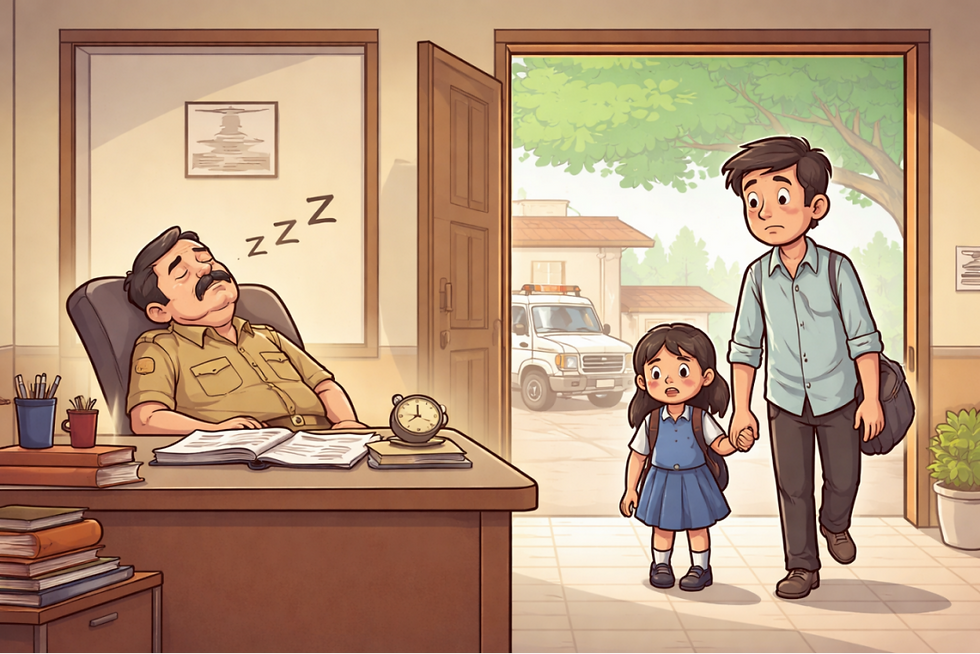
Two-thirty in the afternoon.At Birpur Police Station, the sub-inspector—known to all and sundry as “Slow Inspector”—has just finished two helpings of rice and lentils, wiped his hands, and settled into his chair. A check has risen. He calls it “the Check of Dissatisfaction.”
For to eat lunch in the middle of work means this: without judging food or non-food, edible or otherwise, somehow shovelling everything down the stomach in one go. “Shovelling”—the “shovel” here meaning cow. If only one were a cow! Then at leisure one could bring the stomach’s contents back to the mouth and chew again. Humans, alas, are denied this facility.
Now, whenever something enters his stomach, yawning is the inspector’s lifelong habit. While yawning, he feels like closing his eyes for a while. He closes them once, then opens them again—thinking, what if someone has arrived? He wants to keep them shut, but cannot. Very much like “eating but not swallowing.” Then, sensing a gap, he rolls his eyes all around, and if he sees nobody, the pair of eyes slowly and peacefully give up.
But is there peace even then?
The nose now makes a demand—who’s watching? It too finds an excuse, and begins humming softly, in the bamboo-flute tune of the Sundarbans. As a result, the news that the inspector is sleeping while sitting in office travels by sound-waves, reaching even the cups of tea in the four shops outside the station. His ghor-ghor ghor-ghor roar makes even the reeds tremble.
At that point, tea-seller Nab comes and informs the station guard,“People are laughing a lot while drinking tea.”
The guard then wakes him with very, very loud coughing or bench-thumping. The inspector springs up and chants a single sentence only:“A fellow can’t even take a little rest—neither at home, nor at office!”
Today also, Slow Inspector has just finished lunch and leaned back into his chair. He has loosened the belt from his belly. He has pulled the front chair closer, lifted both legs, and unfolded them from their daily wrinkles. His eyes are blinking-blinking, the nose is on ‘On-Your-Mark’, and exactly then—sleep is disturbed.
Before fasting even begins, his eyes grow wide. He sees an odd fellow entering the station with a small girl. She is crying fiercely.
The man quickly folds his hands and says,“Sir, perhaps you were resting. I disturbed you at the wrong hour. There was no alternative but to come.”
The inspector sits up a little and says,“Don’t sing the song of slowness. Come to the real matter. What work have you come for?”
The visitor said,“Sir, my name is Gagan. I live on the eastern side of your police-station area, in Bidhannagar Colony. I was passing along the road when I saw this little girl crying for a long time under the tamarind tree. She wouldn’t tell her name or address—nothing at all. She is wearing school uniform, but there is no schoolbag with her. Times are not good these days. So I brought the girl straight to the police station.”
Slow Inspector was slightly irritated at first. The matter took a little time to become tyre—that is, to get grip. Sleep, after all, was peeping in through the doorway! But thanks to this man’s nuisance, it got no opportunity. Muttering something under his breath, the inspector tightened the loosened belt again—without getting up from the chair. Then he said,“You did well to come to the police station. This is the one and only place for solving all problems. House, family, household, neighbourhood, town—whatever happens wherever, this is the single office meant for setting everything right. You could simply have asked where the girl’s home is and dropped her there—problem finished. Or was it that without coming to the police station your lunch wouldn’t digest, brother?”
Gagan Babu, instead of getting flustered, smiled broadly and said,“That’s where the fear lies, sir. You know the saying—the trouble of doing good. Something like that. I cannot ignore someone’s distress. And at home, do I get any less scolding? They say I have no work other than chasing stray wax balls around the house. They are not wrong. Just look—so many people are coming and going, but nobody asked the girl why she was crying. But seeing her cry, I was reminded of my own daughter. And why did I come straight to the police station? Listen to the story. Once I returned a lost child home—what a scandal, what a scandal! The family mistook me for a child-kidnapper and put me in jail and all that! Since then, I’ve taken a firm lesson by the ear. If, out of compulsion to help, I ever do anything… then first I’ll knock once at the police station and inform everything. If you touch the old woman, the crocodile won’t dare play games, sir. That’s why I came to trouble you…”
By now, the little girl had stopped crying and was sitting quietly. She was wearing school uniform. The school’s name was not written anywhere. No bag on her back.
After a while, she looked up at the officer and said,“I want to go home. But before that, I want to go to school once. I left my book-bag in the classroom. If I return home without it, my mother will scold me very badly.”
Hearing this, even the officer felt a tug of affection. His own daughter, in childhood, had once got lost while going to see the Rath procession. Policeman though he was—what anxiety that had caused!
The inspector said to the girl,“First eat a little milk and biscuits. Then we’ll see.”
Then he shouted for Constable Barun.
Barun came running at once. Seeing the little girl and the man, the constable asked,“Sir, is the girl your niece by any chance?”
At this, the inspector’s head became hot once again. It felt as though Barun had poured gunpowder directly into his skull. He shouted,“You’re on duty at the station gate, and you have no idea who is entering or leaving? When this child was walking into the station crying her eyes out, were you sleeping?”
The constable, without enlarging the matter, said,“Forgive me, sir. Tell me—what is to be done?”
The inspector said in a heavy voice,“Tell Nab to bring a little milk and biscuits for the girl.”
Then Slow Inspector looked at the child. Once again his own daughter came to mind. His daughter too had once been just this small. Today she has grown up and is studying in college. In a few days, perhaps if she gets a job, she will go somewhere else. Inside his mind he thought, “It’s true—parents get their children close to them only for a few days. And within that short time, if sorrow and pain must make them cry, that cannot be accepted.” His heart softened like butter left near a warm stove.
Getting up from the chair, he stroked the girl’s head and asked,“What do you like to eat?”
He gave the girl a glass of water to drink.
Forgetting her tears, the girl said happily,“I like dipping crunchy biscuits in hot tea and eating them. Will you give me some, Uncle?”
Hearing the word “Uncle,” the inspector’s mind wandered off somewhere.
“Of course I will. I see your taste is just like mine. When I was small, I too loved dipping crunchy biscuits in tea,” said the inspector.
Hearing this, Barun said,“Then shall I tell Nab to send two plates?”
The inspector replied,“Tell him four cups of tea. We’ll drink, and will you and Gagan Babu just stand staring with music playing in your mouths?”
After a little while, shopkeeper Nab arrived with tea and biscuits. By then, the inspector had learned the girl’s name—Misti. It suited her very well. Still, she had not yet said why she was crying instead of going home.
While eating tea and biscuits, Slow Inspector asked the girl,“Alright then, now tell me, Misti dear—why were you sitting under the tamarind tree crying instead of going home from school? And what are your parents’ names? Where is your home?”
Misti stared fixedly at the inspector. Seeing this, Gagan Babu said,“Tell us, child. Don’t be afraid. Where is your home? Why were you crying? If you say everything, the officer will arrange to send you home.”
Misti said,“I will not go home. If I go, Father and Mother will scold me a lot. They scolded me badly yesterday too. Today they might scold me even more. I will stay here.”
This time the inspector said,“If you don’t tell your parents’ names and where you live, you can’t be kept here, child.”
What Misti understood, who knows. She said,“My father’s name is Manik Das. Mother, Minati Das. My name is Misti Das. Our house is in Sharang Pally, behind the Kali temple.”
“So which school, which class do you study in?” the inspector asked.
“In Sarada School, Class Three.”
“Why were you crying instead of going home?”
“The day before yesterday, the maths exam result came out. All my friends got A plus. I got B plus. Father scolded me a lot. He said, ‘If you get B plus in any test again, I’ll scold you badly.’ Today another test result came out. That too was B plus. So out of fear I didn’t go home.”
Meanwhile, seeing that even after one o’clock the girl had not returned from school, Misti’s mother, Minati Devi, became quite worried. Putul studies in the same school, same class, along with Misti. She phoned Putul’s house. She asked whether Putul had returned from school.
Putul’s mother said,“My daughter came back a long time ago. Try calling the bus driver once, or the school.”
This time Misti’s mother phoned the bus driver. As she dialled, her hand seemed to tremble. From worry, her body was beginning to feel strangely numb. The driver’s phone was switched off. Minati Devi’s head felt as though it would tear apart. Without delay, she phoned Misti’s father. She told him that the girl had not returned home. She also told him that classmate Putul had already come back.
A mother’s mind—it can accommodate many thoughts about her child. She said,“Yes, you know… yesterday you scolded her so much for getting B plus. Out of that fear, the girl…”
Cutting her off mid-sentence, Misti’s father said,“If you don’t discipline children, they will never correct their mistakes—do you understand? If you’re too soft, children can’t be raised properly—remember that. But today there was no talk of any exam result coming out. Wait, I’ll go to her school and inquire. Don’t worry.”
Minati Devi’s eyes filled with tears. In a trembling voice she said,“Go at once. Don’t be late.”
Hearing from Misti’s own mouth that she had been scolded for getting B plus in mathematics, and that today again she had got B plus in another test and therefore had not gone home out of fear, the inspector said,“Nowadays I really lose patience with parents! They don’t want to know what their children are interested in. But the results must be like the Bay of Bengal—deep, vast, and overflowing.”
Calling Barun, he said,“Go immediately to Sharang Pally, find out, and bring her father here at once.”
Constable Barun didn’t have to go anywhere. Just then, a gentleman and a lady rushed into the police station. Their faces carried the mark of terror. Entering, the moment they saw Misti, they lifted her into their arms and said,“Here she is—we’ve found our daughter!”
The father said,“What worry we were in! Where were you all this time, child?”
That they were Misti’s parents needed no further understanding. Still, the inspector wished to hear it from Misti herself and asked,“Do you know these people?”
Misti said,“My father and mother.”
Slow Inspector kept staring at Misti’s father. Then, raising his voice, he said,“What kind of child-rearing is this, sir? A girl is afraid to go home if she gets B plus!”
Hearing this, Misti’s mother, Minati Devi, said,“I had already told her father not to scold her so much.”
She asked the girl,“Which test result came out today again, child, that out of fear you didn’t return home?”
The inspector said angrily,“You people are the root of all soil! You yourselves become roots and then want your children to be nothing but soft, soft scribbles. How many times did you get A plus in your childhood, tell me?”
Misti’s parents both remained silent. Manik Babu said,“Sir, this mistake will never happen again. We even went to the school and couldn’t find her. We saw the bag lying in the classroom. The principal told us to inform the police. We came running and running. What terror we were in!”
The inspector said,“If this gentleman had not brought the girl from the tamarind tree to the police station, you might not have found your daughter at all. Do you keep track of how many people roam around with bad intentions?”
Hearing this, tears came to Misti’s mother’s eyes. Just then, the phone rang in the police station. Slow Inspector picked it up.
From the other end, the school principal asked,“Sir, a student named Misti Das, Class Three of Sarada School, has not returned home. I have sent her parents to the police station. I am calling to inquire about the matter.”
The inspector informed him that Misti had been found. He said,“Along with students, educate their guardians also. Make them understand—if one gets B plus instead of A plus, the Mahabharata does not become impure.”
The principal said,“We do tell parents again and again in meetings not to put pressure on children.”
Putting down the phone, the inspector asked Misti,“So then—which test result came out today, child?”
Misti’s mother hugged her and said,“Whatever result you get, child, we will never scold you again.”
Misti took the test result out of her pocket and said,“They have given me B plus again this time, Ma.”
The inspector took the report from Misti’s hand and looked at it. He was struck speechless. Whether to laugh or to cry, he could not decide.
A few days earlier, in school, blood tests had been done for all the girls to record their blood groups. Today they had given that report. Misti’s blood group was B positive. That was written in big letters—B PLUS.
Out of fear of that B plus, it was as though Misti’s blood itself had been trying to turn into water. She had thought that today perhaps Father would not even allow her to enter the house.
Showing the B plus of the blood-test report to Misti’s parents, the inspector said,“Do you understand how frightened your daughter became?”
With head lowered, Manik Babu remained silent. In Misti’s mother’s eyes too, tears were now brimming.


Comments