


11Milli Seconds
- Development Connects

- Apr 7
- 10 min read
The scientific seed here is a real recent advance: in February 2025 Oxford researchers reported teleporting logical quantum gates between separate processors over a network link, and in November 2025 Stuttgart researchers reported a key quantum-repeater teleportation milestone toward a quantum internet.
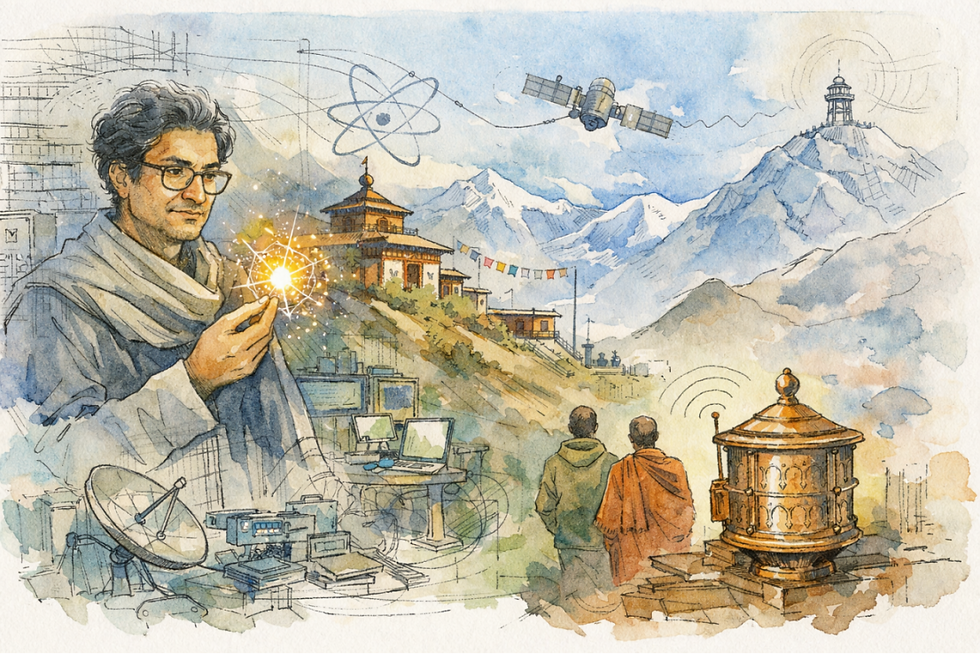
On the evening in question we were sitting, as civilized men have sat since the fall of empires, around a chipped centre table under a lazily rotating fan in Bagha Jatin, while rainwater dripped from a stubborn corner of the veranda with all the discipline of a government file. Bapi had brought muri mixed with mustard oil and green chilli, Nayan was ruining it by adding sev, and I had just decided that civilization was doomed when Dr. Samudra Garjan, whose spectacles alone carried more authority than most committees, looked up from the newspaper and said in a tone of tired irritation, “The trouble with the twenty-first century is not that people know too little. It is that they hear the phrase quantum internet and immediately imagine faster cinema downloads.” We knew that tone. It meant thunder, revelation, and possibly unpaid tea. I asked, in my capacity as youngest listener and therefore authorized fool, “What is a quantum internet then, sir?” He fixed me with the gaze of a man who has forgiven electrons for existing but not undergraduates. “A network,” he said, “in which information is shared not merely by sending signals but by exploiting entanglement—correlations so deep that two particles behave as parts of one mathematical story even when separated. Ordinary internet sends bits. Quantum networking distributes fragile quantum states. One is like passing chits in class. The other is like two perfectly trained Kathak dancers turning together without seeing each other.” Nayan grinned. “And I suppose you have already saved such a network once?” “Saved?” said Samudra Garjan, folding the paper. “My dear boy, had I not intervened, by now three nations would have accused one another of cyberwar, one Swiss lab would have melted a refrigerator colder than Pluto, and a Himalayan monastery would be storing the world’s first illegal ghost signal in a copper prayer wheel.”
Now once Samudra-babu started like that, none of us dared interrupt for long. He leaned back, accepted tea with the absent-minded majesty of a king accepting tribute, and began. The matter, he said, had started not in Switzerland, not in America, not even in some dramatic volcanic island where scientists insist on building observatories, but under his own building in Bagha Jatin, in the concealed laboratory below the scooter stand and the suspiciously innocent water pump. It was a Tuesday, which he distrusted on principle, and his assistant Ritwik had been attempting to align a pair of optical cavities while simultaneously eating telebhaja over a cryogenic console. “There are only two serious enemies of precision science,” Samudra said. “Thermal noise and besan crumbs.” At 1:43 in the morning a monitor attached to what he called, with false modesty, his modest domestic entanglement verifier emitted a squeal unlike any earthly machine and printed a stream of nonsense symbols. Ritwik thought it was a software bug. Samudra knew better. “Software bugs produce stupidity,” he explained. “This was elegance. Randomness is noisy. Malice is clumsy. But what I saw was precise corruption.” The lab had been monitoring public quantum-network test traffic from several experimental facilities worldwide—perfectly legally, he added before I could ask, because the metadata was open and the physical signatures could be passively sensed. Several labs had recently demonstrated pieces of what journalists lazily called a quantum internet: teleporting logical operations across linked processors, and separately, teleporting quanta between distant light sources, both crucial because quantum states cannot simply be copied the way ordinary files are. Copying a quantum state exactly is forbidden by the no-cloning theorem; one must preserve it, relay it, or reconstruct it using entanglement and classical information. “Which,” said Nayan, “means the universe itself has copyright law.” “At last,” Samudra nodded, “you understand physics.”
The anomaly was subtle. Across three experimental nodes in Europe and one in Singapore, entanglement-distribution attempts were failing for exactly eleven milliseconds whenever a certain calibration packet passed. Not failing randomly—failing with style. In one case a Bell-state measurement produced the wrong parity. In another, memory qubits decohered as if nudged by a whisper. In a third, a photon arrived on time but bore the wrong phase relationship, as though some invisible hand had twisted its wavefunction half a sigh to the left. “Imagine,” Samudra told us, drawing on the damp tabletop with his finger, “that four orchestras in different countries are trying to play a single note together. They cannot see one another. They depend on exquisitely synchronized tuning forks. Now suppose a prankster does not strike the drums, does not cut the power, does not even touch the violin—but merely warms the tuning forks by a fraction and changes the hall humidity by a breath. The performance collapses, and everyone blames the conductor.” Ritwik, who had the virtues of loyalty and slow astonishment, suggested reporting it quietly. But before they could, journalist Ananya Sen came tearing into the lab at dawn carrying three things: wet hair, a half-charged tablet, and global panic. Two technology blogs were already muttering about impossible packet losses in quantum-network demonstrations. A security forum had declared sabotage. One retired intelligence officer on television had blamed “hostile state interference,” which is the preferred phrase of men who have no equations but own neckties.
By noon, according to Samudra, he had been contacted by one Dr. Meera Rao, a person in a government scientific directorate whose official designation shifted, for reasons of national amusement, every six months. She needed discretion. Three partner labs had gone semi-dark. A courier had vanished between Zürich and Milan. And a monastery in Spiti, absurdly enough, had appeared in the logs of a secure routing experiment though no quantum node was supposed to exist there. “Why would a monastery appear in a quantum network?” I asked. Samudra gave me a look of pity. “Because monks,” he said, “are one of the last surviving communities who understand patience, timing, silence, and repetitive protocols. In short, ideal experimental collaborators.” As it turned out, a small off-grid physics group had indeed partnered quietly with a European team to test free-space timing transfer in mountain air. Thin atmosphere, low thermal fluctuations, cooperative skies, and absolutely no tourists after sunset—excellent conditions if one wished to bounce delicate optical signals between peaks. Unfortunately, the same conditions were excellent for hiding a parasitic device.
Samudra took the next flight north, though not, he stressed, by choice. “Aviation meals are an indictment of the species.” From Chandigarh he went by jeep, then by a truck carrying gas cylinders and devotional calendars, then on foot, accompanied by Dr. Rao, a glum local engineer, and a mule with the expression of a disillusioned philosopher. The monastery stood on a ridge like a thought someone had forgotten to erase. Prayer flags cracked in the wind; snow peaks shone like sharpened bones; and above the prayer hall a slim tower carried what should have been a harmless optical timing receiver. It was not harmless. Samudra examined it with binoculars and declared, “Either these monks have become extremely interested in quantum key distribution, or someone has attached a phase-scrambling sidecar to the receiver.” Nayan interrupted. “Phase-scrambling?” “A small device,” said Samudra, “that alters the phase of light pulses. In ordinary optics phase is the alignment of a wave’s peaks and troughs. In quantum networking, phase can encode part of a qubit’s information. Disturb it delicately enough and you do not simply jam the message—you make it fail in ways that resemble natural noise.” “Meaning,” I said, “the perfect crime.” “No,” he replied. “The perfect graduate thesis. Crime requires better paperwork.”
The abbot, far from being shocked, turned out to be mildly annoyed. For weeks, he said, one foreign visitor had been “measuring silence” at odd hours and asking whether the bells could be rung with millisecond precision. That phrase alone, according to Samudra, was enough to identify the man as a scientist, because no ordinary villain ever says millisecond precision unless invoicing for it. In the storage room beside a copper prayer wheel they found the rest of the apparatus: compact cryogenic shielding foam, a portable rubidium clock, narrow-band photon detectors, and a hand-built entanglement sniffer. “A what?” said Bapi. “An unauthorized diagnostic node,” Samudra answered. “Something that tries to infer the presence and structure of entangled traffic without fully participating in the protocol. Very difficult. Very clever. Also very rude.” The intruder had not been trying to steal messages directly. That would be almost impossible without detection if the protocol were sound. He had been trying to map the network’s weak points by inducing minuscule, patterned errors and watching how correction routines responded. In plain language, he was tapping the bones of a bridge to learn which beams would crack first. If successful, he could later force diplomatic communications, financial timing systems, or distributed sensors onto compromised routes. It was espionage by metronome.
But he had made one mistake. “Arrogance?” I ventured. “Certainly,” said Samudra, “but more specifically, ignorance of mountain weather and Bengali irritation.” The sidecar’s scrambling routine produced those eleven-millisecond failures with machine perfection. Too perfect. In cold thin air, no optical path is that stable. Real atmospheric turbulence would add jitter; ice crystals would broaden arrival times; thermal drift would wobble the phase. Yet the corruption intervals were exact to the microsecond. The intruder had modelled a laboratory, not a mountain. Samudra realized the device must be compensating actively with an external reference. He traced a buried cable not to the official timing unit but behind the old prayer hall, where a polished brass cylinder had been inserted inside the axle of the giant copper wheel. The monks had thought it an offering. It was a cavity-stabilized oscillator powered by hidden thermoelectrics exploiting the day-night temperature swing. “Elegant engineering,” Samudra admitted. “Villainy often is. That is why it is so exhausting.” Once they knew the oscillator was there, the rest unfolded quickly. The rogue node needed line of sight to a relay station across the valley. Samudra climbed to the roof at dusk, waited for the temperature inversion, and using nothing more glamorous than a modified amateur telescope, some smoked glass, and what he described as “respectable patience,” spotted a blinking infrared beacon from an abandoned weather hut.
The confrontation, if one insists on such melodramatic vocabulary, was less pistol and more polarization. Samudra and Dr. Rao crossed the ridge in a wind that could have sanded vertebrae. Inside the hut they found the operator, not a supervillain in silver gloves but a severe young researcher from a private technology consortium who looked sleepless, underfunded, and extremely defensive. His argument, Samudra said, was the most modern of all sins: everybody was going to weaponize the quantum backbone sooner or later, so he was merely exposing vulnerabilities first. “That,” Samudra told him, “is like drilling holes in a dam to prove water is dangerous.” The fellow reached for a shutdown switch. Samudra reached faster—not with a punch, which he disapproves of unless Newton personally insists, but with a pocket laser pointer and a square of glacier goggles. A flash, a reflection, one startled oath, and the operator missed the command window by a fraction. In quantum experiments, fractions are empires. Ritwik, connected remotely from Bagha Jatin, pushed a timing patch into the affected nodes. Dr. Rao isolated the compromised synchronization channel. The rogue system, suddenly cut off from its hidden oscillator, began injecting phase errors into itself. Its own detectors flooded with false coincidences. “Like a liar,” Samudra said, “forced to fact-check his previous lie while inventing the next.” Within ninety seconds the parasitic network collapsed into statistical nonsense.
Yet the most beautiful part, according to Samudra, came after the arrest. To prove the network was clean, they needed a live demonstration. On that Himalayan ridge, with the valley dark beneath and stars hanging low as though curious, the teams ran a test: an entangled link distributed between distant nodes, a Bell-state measurement relayed, a logical operation reconstructed where no direct copy had travelled. Not magic, not matter teleportation, but the transfer of quantum information using shared entanglement plus ordinary classical communication—a choreography impossible in daily life, routine only to equations, and still astonishing when the detectors clicked in agreement. “That,” Samudra said quietly, “is the future. Not because it is flashy, but because it teaches humility. In classical engineering, brute force often suffices. In quantum engineering, the universe demands manners.” The monks, who had understood none of the details and all of the significance, served butter tea while snow began to fall. One novice asked whether the particles had talked to each other through empty space. Samudra replied, “No. They were never as separate as our common sense likes to imagine.” “Like cousins at a Bengali wedding,” suggested Bapi. “Worse,” said Samudra. “Like Bengalis in a family WhatsApp group.”
By the time the incident was buried under classified memos, sanitized press notes, and one infuriating headline about “ghost hacking,” the public only knew that certain experimental quantum links had suffered environmental anomalies. The oscillator disappeared into evidence. The private consortium publicly pivoted to ethical AI, as all repentant sinners now do. The monastery kept the repaired receiver but refused further hidden donations. And Samudra Garjan came back to Bagha Jatin with a slight cold, a deeper contempt for airport sandwiches, and a copper prayer wheel no larger than a teacup. At this point he drew exactly such an object from his pocket and set it on the table. We all leaned in. “Inside,” he said, “is a harmless replica of the stabilizing cavity. Educational only.” Nayan recoiled. “You brought espionage equipment into the para?” “Please,” said Samudra. “In this para the aunties know more about signal interception than most nations.”
The rain had stopped by then. The fan creaked. Somewhere outside a pressure cooker whistled. I looked at the tiny copper wheel and tried to imagine snow ridges, infrared beacons, entangled photons, and our impossible friend striding through all of them with the same expression he used to inspect stale singara. “So the quantum internet is real?” I asked at last. “Real in pieces,” he said. “As all important things begin. A teleported logic gate here, a repeater milestone there, better memories, cleaner photons, smarter error correction. People hear the word quantum and expect miracles. They should expect engineering—difficult, delicate, magnificent engineering.” He rose then, adjusted his shawl, and added in passing, “Also, tell the grocer downstairs to stop placing his Wi-Fi router above my lab entrance. Last week it interfered with a calibration run and briefly entangled my shopping list with a weather model.” We laughed, naturally. But none of us laughed very long, because with Samudra Garjan one never entirely knew where the jest ended and the next scientific adventure had already begun.


Comments