


Global Sustainable Development Review — Weekly Newsletter, 6–12 October 2026

At a Glance — Weekly Global Summary
Reporting period: 6–12 October 2026 | Independent, source-based weekly edition by Development Connects
The 2026 Global Multidimensional Poverty Index, issued by UNDP on 12 October, estimates that 1.2 billion of the 6.3 billion residents of 108 countries live in acute multidimensional poverty, equivalent to 18.9%. The index draws on health, education and standard-of-living indicators rather than income alone. Approximately 617 million of the affected population are children; 83% of multidimensionally poor people live in rural areas. In Sub-Saharan Africa, 616 million people, or 51.4% of the regional population, are affected. The statistical update incorporates surveys from 13 countries and subnational figures for 1,360 regions in 100 countries. Among 89 countries with trend data, 33 have halved their MPI in less than 15 years.
On 7 October, FAO reported that more than 45 million people faced crisis-level hunger or worse across Gaza, Lebanon, Sudan, Syria and Yemen. Its cited country figures include 19.5 million people experiencing severe food insecurity in Sudan, 18.3 million in Yemen and around 7.2 million in Syria in late 2025. Only 23% of Sudan's US$193 million emergency agricultural response requirement for 2026–2028 had been funded. FAO sought US$38 million to support 35,000 conflict-affected farmers and rural households in Lebanon; it also reported damage to more than 22% of that country's agricultural land.
UNDP's 8 October Myanmar poverty report estimated that 68% of the population—more than 37 million people— were either multidimensionally poor or vulnerable to falling into poverty. Health and living-standard deficiencies accounted for more than 80% of multidimensional deprivation. In Rakhine, more than two-thirds of the population were multidimensionally poor. UNDP also documented substantial fuel-price differences between Yangon and several conflict-affected regions.
The UN Sustainable Development Group highlighted an approximate US$4 trillion annual development-financing gap. Separately, on 8 October, the World Bank Group's International Development Association priced a €1 billion 30-year Sustainable Development Bond with maturity in October 2056, a 4.300% coupon, 4.339% yield and 28 investor orders. German investors accounted for 76% of the distribution, and public banks, agencies and institutions for 55%. The bond transaction is a capital-markets issuance, distinct from a development grant. UNDP also published an assessment of the 36 Voluntary National Reviews presented at the 2026 High-Level Political Forum, with attention to SDG 16, government data systems and participation.
At the Pre-COP31 meetings in Fiji and Tuvalu, ADB said recent climate-adaptation finance flows met only about 26% of projected annual needs in Pacific countries. Africa's Great Green Wall received a newly announced US$78 million Global Environment Facility commitment, covering nine Sahel countries, with a target to restore more than 270,000 hectares and improve five million livelihoods. The Great Green Wall figures are planned outcomes. UNEP will implement eight of the ten projects. GLOBAL SUSTAINABLE DEVELOPMENT REVIEW • WEEK 06–12 OCT 2026
The World Bank's October regional economic updates project growth of 2.2% for Latin America and the Caribbean, 4.5% for East Asia and the Pacific, and 6.9% for South Asia in 2026. Latin America and the Caribbean recorded 2.4% growth in 2025. The East Asia outlook includes upward-revised 2026 forecasts of 7.4% for Viet Nam, 5.1% for Malaysia and 2.0% for Thailand. South Asia's 2027 forecast is 6.7%. Across the regional reports, AI adoption, skills, exports and productive investment are examined separately from the published GDP projections.
Sri Lanka's economy grew 4.7% in the first half of 2026, and the World Bank projects annual growth of 4.4% in 2026 and 4.2% in 2027. Estimated poverty was 16.9% in 2025, while the agrifood system supports over 40% of employment. Guinea's economy grew by 7.4% in 2025; inflation fell to 3.2% and estimated poverty stood at 36.8%. Nigeria's real GDP expanded 4.2% in the first half of 2026. Between 2023 and 2025, its aggregate state revenues and spending increased roughly 93% and 92%, respectively, in real terms; the capital-spending share rose from 46% to 61%.
In Yemen, the European Union agreed €9 million with UNDP for locally led recovery in seven governorates and more than 25 districts. A separate €10 million EU–UNDP–FAO agreement covers climate-resilient agrifood systems and jobs. The older SIERY local-governance programme reported 177 public-service projects reaching more than seven million people; those figures are not results of the new MASAR project. Bangladesh and UNDP signed the second phase of a climate budgeting and finance-tracking initiative, scheduled until December 2027, with AFD support.
Iraq launched an updated Nationally Determined Contribution extending to 2035. Its unconditional emissions- reduction targets are up to 3% below business-as-usual by 2030 and 5% by 2035, with a conditional 17% additional reduction subject to international support. Mongolia's Dundgovi Province signed a three-year UNDP cooperation framework for green energy, resource management and local economic development. Malawi issued its 2026 review of all 17 SDGs, incorporating a third Voluntary National Review and first country-led evaluation of health and clean energy. South Africa's GEF Small Grants Programme invited Northern Cape conservation proposals of up to US$30,000 each, with project durations of 12–18 months and applications due by 5 November 2026.
The publishing dates in this issue fall between 6 and 12 October 2026. Measured historical rates, forward GDP projections, funding agreements, investment issuance and programme targets retain their original dates and status. A figure describing a national economy is not converted into an estimate of newly reached households. A financial agreement is not presented as a cash transfer to named beneficiaries. For every article, the originating public agency, publication date and source URL appear beneath the report, allowing the underlying statement and its reporting period to be checked.
Top 20 Detailed Reports
01. Global MPI: 1.2 Billion People in Acute Poverty

UNDP released the 2026 Global Multidimensional Poverty Index statistical update on 12 October. The database covers 108 countries with a combined population of approximately 6.3 billion people. An estimated 1.2 billion people, equivalent to 18.9% of the population covered, are identified as acutely multidimensionally poor. The methodology assesses simultaneous disadvantages in health, education and living standards rather than relying on household income alone. The ten indicators include nutrition, child mortality, years of schooling, school attendance, cooking fuel, sanitation, drinking water, electricity, housing and household assets.
The 2026 update contains new survey information from 13 countries and subnational estimates for 1,360 regions across 100 countries. Around 617 million multidimensionally poor people are children, representing 51.5% of the total. More than eight in ten live in rural areas; the published regional figure is approximately 83%. Sub-Saharan Africa accounts for 616 million people living in multidimensional poverty, or 51.4% of its population. These quantities are estimates for surveyed reference periods, which vary across participating countries. For trend analysis, 89 countries have comparable MPI observations.
The report identifies 33 countries that halved their MPI value in fewer than 15 years, including six countries in Sub-Saharan Africa. The MPI combines the incidence of poverty with the average intensity of deprivation and is therefore not interchangeable with national income-poverty rates. The statistical update is the source of the 2026 headline values; it does not attribute observed national changes to any single policy or intervention. The report also links its monitoring purpose to SDG target 1.2, which concerns reducing poverty in all its dimensions by 2030.
Primary source: https://hdr.undp.org/content/2026-global-multidimensional-poverty-index
02. FAO: More Than 45 Million Face Severe Food Insecurity
The Food and Agriculture Organization reported on 7 October that more than 45 million people faced crisis-level hunger or worse across Gaza, Lebanon, Sudan, Syria and Yemen. The agency described the effect of conflict, displacement, damaged agricultural infrastructure and market disruption on food production and rural incomes. Its regional leadership held discussions with governments, donors and implementing partners about financing emergency support for farmers, herders and fishing communities. FAO's account combines national food-security assessments with different analysis periods and projected conditions. For Gaza and the West Bank, more than 1.2 million people faced Crisis or worse acute food insecurity during April–June 2026; FAO sought US$140.9 million for agricultural assistance and recovery in 2027.
In Lebanon, approximately 1.24 million people were projected to face Crisis or worse conditions between April and August 2026. FAO reported a US$38 million requirement intended to reach 35,000 conflict-affected farmers and rural households. More than 22% of Lebanon's agricultural land was reported damaged; roughly half of agricultural land in South and Nabatieh was inaccessible. Sudan had 19.5 million people experiencing high levels of acute food insecurity. Only 23% of the US$193 million requested under FAO's 2026–2028 emergency response plan had been funded, while FAO reported reaching nearly five million people during 2026 with agricultural inputs, feed, vouchers and livestock services.
Syria had around 7.2 million people experiencing acute food insecurity in late 2025, with a US$171.5 million 2027 assistance request targeting 5.2 million people. Yemen had 18.3 million people at Crisis or worse levels, while less than 1% of FAO's US$87.9 million 2027 emergency and resilience requirement was secured. Country values should not be added without accounting for different dates and methods.
Primary source: https://www.fao.org/newsroom/detail/fao-calls-for-urgent-investment-to-protect-food-production-as-crises-deepen-across-the-near-east-and-north-africa/en/
03. Myanmar: 68% Poor or Vulnerable to Poverty
UNDP published Layers of Deprivation: Multidimensional Poverty in Myanmar on 8 October. It estimates that 68% of the country's population, more than 37 million people, are either experiencing multidimensional poverty or are vulnerable to falling into it. The report measures overlapping deficits in health, education and living standards, including constraints on healthcare, adequate housing, sanitation and clean water. The combined 68% includes people at risk as well as those already classified as multidimensionally poor; it should not be described as a poverty-incidence figure alone.
Health and standard-of-living indicators account for more than 80% of the measured multidimensional deprivation. The report distinguishes patterns across Myanmar: conflict, displacement and restricted service access dominate in some areas, while longstanding deficits in livelihoods, education and infrastructure remain important elsewhere. In Rakhine, more than two- thirds of residents are multidimensionally poor and nearly one-third are severely poor. UNDP notes that phone-based surveys may underrepresent certain displaced and stateless communities, including Rohingya households. Urban differences also appear in the findings. Yangon has a lower regional poverty incidence than many conflict-affected areas but contains a large absolute number of people experiencing deprivation.
UNDP reported around one in five households exposed to climate-related shocks and approximately 600,000 people affected by flooding by the end of August. It also recorded diesel and gasoline prices about 87% and 85% above pre-crisis levels, with some regional fuel prices two to four times the Yangon level. At least one million young people may have left Myanmar since 2021, according to a separate UNDP estimate cited in the release. These are reported estimates, not a new programme's beneficiary counts.
Primary source: https://www.undp.org/asia-pacific/press-releases/two-three-people-myanmar-are-poor-or-one-shock-away-falling-poverty-new-undp-report-finds
04. UN Highlights a US$4 Trillion Development-Financing Gap

On 8 October the United Nations Sustainable Development Group published an account of catalytic finance through the Joint SDG Fund. The report refers to an estimated US$4 trillion shortfall between development-financing requirements and the resources available to advance the Sustainable Development Goals. That number is a financing-gap estimate rather than the value of a new funding pledge. The Joint SDG Fund combines UN-country coordination, public investment priorities and partnerships with financial institutions to support programmes that can attract additional resources. The account describes a transition from supporting isolated projects to structuring investment opportunities that can bring other public and private financiers into sectors related to the SDGs.
Resident Coordinators and UN country teams participate in aligning financing arrangements with national planning and public policy. Catalytic financing is not a single instrument: the described approach can include preliminary technical support, investment preparation, blended financing, guarantees or complementary capital from partners, depending on the project and participating institutions. The United Nations cites its experience mobilising additional funding alongside initial Joint SDG Fund commitments, but financing mobilised must be distinguished from funds fully disbursed and from verified household outcomes. Investment transactions require their own reporting on public costs, leverage, maturity, expected uses and implementation.
The October publication highlighted the financing strategy and examples rather than issuing a complete country-by-country schedule of the US$4 trillion gap. Its subject is the institutional and financing arrangement under SDG 17. The comparison between the estimated annual gap and individual project amounts gives a scale reference; it is not a direct measure of individual projects' effectiveness.
Primary source: https://unsdg.un.org/latest/stories/how-catalytic-finance-reshaping-development
05. IDA Prices a €1 Billion Bond Maturing in 2056
The International Development Association, a World Bank Group institution focused on low-income countries, priced a €1 billion Sustainable Development Bond on 8 October. The issue has a 30-year maturity and is due to mature on 16 October 2056, after settlement on 16 October 2026. The issue yield was 4.339% per year, its fixed coupon was 4.300%, and the offer price was 99.353% of face value. The denomination was €1,000 and the issue was arranged for listing on the Luxembourg Stock Exchange. World Bank Treasury reported 28 investor orders.
By investor geography, Germany accounted for 76% of distribution, the rest of Europe 11%, and other regions 13%. By institution type, public banks, public agencies and other public institutions received 55%; asset managers, insurers and pension funds received 43%; and central banks accounted for 2%. BNP Paribas, Deutsche Bank and DZ Bank served as joint lead managers. IDA described the transaction as its first euro benchmark issuance of the fiscal year and its largest 30-year bond issuance. The bond was issued with IDA's Aaa/AAA credit standing and had a 42.8-basis-point spread against the reference German Bund.
IDA bonds raise capital to support its financing programme; they are not equivalent to direct grant announcements to named recipients. The institution reports providing more than US$632 billion for investments in 115 countries since 1960. The funds raised by such bonds support the institution's wider development financing activity through approved projects and programmes. The press release does not allocate the entire €1 billion issue to a newly announced project or provide a fresh total of people reached by this specific security.
Primary source: https://www.worldbank.org/en/news/press-release/2026/10/08/strong-investor-demand-backs-new-ida-eur-30-year-global-benchmark-bond
06. UNDP Examines Governance in 36 National SDG Reviews

UNDP released SDG 16: 2026 Voluntary National Reviews through the Lens of Peaceful, Just, and Strong Institutions on 8 October. The publication examines the 36 Voluntary National Reviews presented at the 2026 High-Level Political Forum on Sustainable Development. These national reviews are state-led reports that describe progress, constraints and implementation approaches under the 2030 Agenda. The publication analyses how governance themes appear within development reporting rather than introducing a new global governance ranking. The 2026 High-Level Political Forum reviewed SDGs 6, 7, 9, 11 and 17 under its agenda of transformative, equitable, innovative and coordinated action.
UNDP assessed the reporting through SDG 16, including the treatment of peace, justice, participation and strong institutions. It examined examples from different world regions, particularly digital innovation in public institutions, monitoring and data systems, and multi-stakeholder engagement. The 36 documents form the review's evidence base, not a sample of countries selected for a new grant programme. The publication records growing attention to the role of accountability, rights and participation across different policy sectors. It distinguishes standalone SDG 16 indicators from the way governance institutions influence water, energy, infrastructure, urban development and partnership programmes.
VNRs are voluntary reports, meaning their coverage, indicators and depth differ by country. References in a VNR to a reform or planned mechanism do not themselves establish its measured effect on service quality. The UNDP publication provides a comparative account of national reporting and institutional practices and is dated 8 October 2026; the national developments it describes may have occurred earlier in the implementation period.
Primary source: https://www.undp.org/publications/sdg-16-2026-voluntary-national-reviews-through-lens-peaceful-just-and-strong-institutions
07. ADB: Pacific Adaptation Finance Meets Only 26% of Needs

Asian Development Bank President Masato Kanda took part in Pre-COP31 discussions in Fiji and Tuvalu, according to a release dated 7 October. Meetings included Fiji Prime Minister Sitiveni Rabuka, Tuvalu Prime Minister Feleti Teo and other Pacific representatives. At the leaders' plenary, ADB reported that recent adaptation-finance flows would meet only 26% of projected annual needs for Pacific countries. The 26% is a regional financing-coverage comparison, not the amount delivered by ADB alone. Discussions covered the effects of rising seas, shoreline exposure and climate impacts on communities and livelihoods.
Pacific governments also identified complex procedures for accessing international finance. The bank's account addresses the relationship between available financing instruments and the operational requirements that governments must satisfy to prepare, approve and implement projects. Adaptation projects can concern coastal protection, resilient infrastructure, water systems and other protective investments, but the October release does not convert the 26% ratio into a complete, separately verified total of projects delivered. The meetings preceded the next UN climate conference and formed part of discussions with island- state governments and international financing institutions.
ADB's president called for faster access to resilience financing, while the bank described its broader support for countries confronting climate impacts. A projected financing requirement is not the same measure as economic damage already incurred, and a reported funding flow is not necessarily a completed adaptation asset. The release therefore identifies a quantified financing gap and an institutional discussion, rather than announcing that the remaining 74% of needs have been financed. The Asian Development Bank described its meetings as part of its regional engagement at Pre-COP31, not as a new round of country-specific loan approvals.
The leaders discussed practical adaptation needs at the national and community levels.
Primary source: https://www.adb.org/news/adb-president-joins-pre-cop31-calls-faster-resilience-finance
08. GEF Commits US$78 Million to the Great Green Wall

UNEP announced a US$78 million Global Environment Facility commitment on 6 October for ecosystem restoration and livelihoods across nine countries associated with the Great Green Wall. The countries are Burkina Faso, Chad, Ethiopia, The Gambia, Mali, Mauritania, Niger, Nigeria and Senegal. The programme consists of ten projects, eight of which will be implemented by UNEP. It aims to restore more than 270,000 hectares of degraded land and improve livelihood opportunities for five million people, with women representing more than half the intended beneficiaries. The announcement links land restoration with agriculture, forests, grazing areas, biodiversity and economic opportunities.
UNEP identifies landscape degradation and climate pressure across the Sahel as the environmental context for the programme. The initiative builds on the Great Green Wall established under the African Union in 2007. Countries have different ecological settings and planned interventions, including forest management, restoration of agricultural land and action in wetlands and semi-arid landscapes. The US$78 million figure is a new GEF commitment, while the restoration area and beneficiary totals are forward-looking programme targets. They must not be counted as hectares already regenerated or households whose incomes have increased.
UNEP and project partners will need to report implementation results for the separate projects, including areas treated and maintained, ecological condition and the livelihoods reached. The announcement also discusses participation by women in proposed interventions. The programme's reported scale concerns a multi-country portfolio rather than a single continuous tree-planting site. UNEP says the programme works through projects designed for different national landscapes, rather than treating all hectares as a single planting site. Project-level reporting will distinguish natural regeneration from other restoration approaches.
Primary source: https://www.unep.org/news-and-stories/press-release/new-us78-million-initiative-restore-land-improve-livelihoods-across
09. Latin America and the Caribbean: 2.2% Growth Outlook

The World Bank's October 2026 Latin America and Caribbean Economic Update projects regional growth of 2.2% for 2026, compared with 2.4% recorded in 2025. The report documents differences among countries rather than one uniform path across the region. El Salvador and Paraguay are identified among economies growing faster than the regional average; Panama and the Dominican Republic also feature among stronger performers. Argentina is projected to expand during 2025, 2026 and 2027, subject to the assumptions underlying the outlook. The report analyses the implications of high real interest rates, public debt burdens and restricted fiscal space for credit, investment and public expenditure.
It also assesses the use of artificial intelligence by firms and workers. A median of 17% of working-age adults across the region reported using generative AI tools, approximately half the comparative rate in the United States and Canada cited by the World Bank. The bank distinguishes basic access or experimentation with AI from integration into firms' principal business processes. Its labour-market analysis estimates that around 8% of workers occupy higher-skill, knowledge- intensive jobs that may be enhanced by AI applications, while roughly 10% work in routine cognitive occupations with greater potential exposure to automation of particular tasks.
Around one-quarter work in routine manual occupations that could face exposure over a longer period as automated hardware changes. These are occupational exposure categories, not observed job losses. The report discusses workforce training, management capability, business-process changes and the use of smaller locally adapted AI applications. The 2.2% growth rate remains a forecast of aggregate output, not a measured AI effect.
Primary source: https://www.worldbank.org/en/news/press-release/2026/10/06/latin-america-caribbean-economic-update
10. East Asia and Pacific: Regional Growth at 4.5%

The World Bank projects 4.5% economic growth in East Asia and the Pacific for 2026 in its October regional update. The report links stronger-than-expected performance in parts of the region to manufacturing and exports of high-technology products, including goods associated with worldwide AI investment. Growth is uneven across national economies and industries. The forecast is a regional projection and should not be treated as the actual final GDP outcome for 2026. The update revises Viet Nam's 2026 growth projection upward by 1.1 percentage points to 7.4%.
Malaysia's projection increases by 0.7 percentage point to 5.1%, and Thailand's by 0.7 percentage point to 2.0%. These revisions concern individual country forecasts relative to an earlier assessment. They are not rankings of development outcomes or measures of poverty reduction. The report also considers global demand, policy conditions and the technology-related production cycle. The World Bank examines both technological production and the capacity of firms and workers to adopt AI applications. It discusses differences in infrastructure, workforce skills and institutional settings, along with the need to distinguish employment in technology-intensive industries from employment elsewhere.
Export gains linked to data-centre or AI-related demand do not automatically translate into benefits for every household. The publication identifies investment and reform priorities that might support productivity and jobs, but does not present a single measured job-creation total attributable to AI across the region. The update is dated 6 October 2026 and includes economic observations made before that publication date. Growth rates refer to output across the whole economy, whereas the high-technology export information concerns selected industries. National projections use the World Bank’s October update, not a later national statistics release.
Primary source: https://www.worldbank.org/en/news/press-release/2026/10/06/east-asia-and-pacific-holds-steady-amid-global-uncertainty-but-harnessing-ai-s-ful
11. South Asia: 6.9% Growth and the AI Transition

The World Bank's South Asia Economic Update, Adopting AI for Growth, was released on 6 October. It projects regional GDP growth of 6.9% in 2026, followed by 6.7% in 2027. The bank identifies domestic demand, remittance inflows and earlier structural reforms among the factors supporting regional activity. The projection is an economy-wide forecast; the estimated 6.9% rate is not a separate estimate of the contribution from artificial intelligence or digital services. The update examines the adoption of AI in firms, government services and production systems across South Asia.
The World Bank reports that adoption is increasing but remains behind advanced- economy levels. Examples cited in its reporting include AI-supported weather forecasts delivered to smallholder farmers in India and AI-assisted retinal screening in Bangladesh. These are examples of applications rather than verified regional totals of users or beneficiaries. The report discusses barriers to adoption among smaller firms as well as the availability of skilled workers, affordable technologies and supporting infrastructure. The 2027 slowdown to 6.7% is a forecast subject to uncertainty over global demand, energy prices, financial conditions and regional economic developments.
The report addresses potential effects of new technologies on labour productivity, exports and public-service capacity and identifies policies that could influence those effects. Employment changes attributable to AI cannot be inferred from regional growth projections alone. Published numerical estimates refer to the defined calendar years, while country-specific fiscal-year projections can differ. The October report is a regional analytical publication, not a new multi-country financing agreement or a confirmation that specified numbers of jobs were created during the week.
Primary source: https://www.worldbank.org/en/news/press-release/2026/10/06/south-asia-s-strong-growth-defies-global-headwinds
12. Sri Lanka: Recovery With Poverty at 16.9%

The World Bank's October Sri Lanka Development Update reports that real GDP has returned to its level before the economic crisis that began in 2022. Output expanded by 4.7% in the first half of 2026, completing twelve consecutive quarters of expansion. The bank projects growth of 4.4% for the full calendar year and 4.2% for 2027. Improvements in industrial activity and services are among the recent contributors, while macroeconomic stabilisation and debt restructuring form part of the recent policy setting. The poverty rate nevertheless remained at an estimated 16.9% in 2025.
The bank reports that income and labour-market conditions have recovered less fully than aggregate production. Its special focus is the agrifood system, which spans farming, food processing, distribution and associated activities. Primary agriculture contributes around 8% of GDP, whereas the broader agrifood system accounts for about one-sixth of economic output, over 40% of employment and nearly one-third of merchandise exports. The report lists tea, coconut, cinnamon, seafood and rubber-based manufacturing among established export-related industries. It identifies restricted access to land and finance, limited value addition, infrastructure gaps and investment constraints as factors shaping the sector.
Recommendations cover agribusiness investment, processing, market access, technology, trade arrangements and productive infrastructure. These are policy proposals, not observed production increases resulting from their future adoption. The GDP forecasts relate to 2026–2027, while the poverty estimate concerns 2025. They should be reported with their distinct periods rather than combined into one current-year measurement. The bank also reports an improved primary budget balance and a recovery of industrial investment. These macroeconomic indicators concern government finances and production, not the distribution of recovery among individual households.
Primary source: https://www.worldbank.org/en/news/press-release/2026/10/02/sri-lanka-s-economy-reaches-pre-crisis-levels-but-recovery-uneven
13. Guinea: Mining-Led Growth and a 36.8% Poverty Estimate

The World Bank published its third Guinea Economic Update on 7 October under the title Beyond Mining: Turning Natural Resource Wealth into Private Sector Growth and Jobs. It reported that Guinea's real economy expanded by 7.4% in 2025. Mining, including bauxite production, was a major contributor, while services recovered and agricultural activity also expanded. The report places economic performance within the country's natural-resource-dependent production structure and discusses private-sector participation and employment. Inflation declined to 3.2%, according to the update, while the estimated national poverty rate fell to 36.8% in 2025.
These are different indicators: inflation measures price changes, growth measures aggregate output and poverty estimates describe the population below the applicable poverty threshold. They cannot be treated as equivalent evidence of improved living conditions. The bank refers to continued mining investments and the gradual commissioning of the Simandou production project in its medium-term outlook. The publication considers the capacity of Guinea's private sector to benefit from infrastructure, skills, finance and commercial opportunities associated with the mineral economy. It discusses diversification and the role of agriculture and services rather than treating mineral-export revenue alone as proof of broad job creation.
The annual economic growth figure refers to 2025 and was reported during October 2026. The report's discussion of forthcoming production, reforms and employment effects is forward looking. Verified employment totals and household income changes from any newly proposed programme would require separate evidence after implementation. The report is the third edition of this country economic update. Its assessment connects the Simandou investment programme with expected changes in export and industrial activity but does not claim that all planned private-sector jobs already exist.
Primary source: https://www.worldbank.org/en/news/press-release/2026/10/07/guinea-economic-update-2026-natural-resource-wealth-private-sector-growth-jobs
14. Nigeria: State Revenues Rise 93% in Real Terms

The October Nigeria Development Update, Beyond the Federal Purse, reports real GDP expansion of 4.2% in the first half of 2026. The comparable first-half growth rates were 3.9% in 2025 and 3.5% in 2024. Services were a major contributor, with a stronger contribution from agriculture. The World Bank also reports that the current-account surplus increased from US$8.6 billion, or 6.7% of GDP, in the first half of 2025 to US$12 billion, or 7.1% of GDP, in the first half of 2026. The update examines the distribution and expenditure of increased fiscal resources among Nigeria's states.
Between 2023 and 2025, aggregate state revenues rose about 93% in real terms, calculated using constant 2019 prices. Aggregate state expenditure increased by about 92% over the same period. Capital spending expanded from 46% to 61% of total state expenditure. These figures describe changes in budget revenue and expenditure, not automatically the results experienced by households using public services. The report attributes rising state receipts to factors including statutory revenue allocations, VAT collections, refunds, settlement of prior federal obligations and specific intervention resources. It also analyses the expenditure composition across economic infrastructure and social services.
Transport investment was one prominent category, while education, health, housing, agriculture and social protection were also examined. The publication calls for better measurement of spending effectiveness and service outcomes. Its figures establish the public-finance pattern through 2025 and a first-half 2026 economic update; any improvement in school learning, clinical access or safe water coverage requires service-level evidence rather than inference from revenue growth.
Primary source: https://www.worldbank.org/en/news/press-release/2026/10/08/higher-revenues-better-lives-strengthening-state-spending-for-growth-jobs-services
15. Yemen: €19 Million Across Two New EU Agreements

The European Union and UNDP signed a €9 million agreement on 6 October for a new locally led recovery programme in Yemen. Mobilizing Area Solutions for Action and Recovery, or MASAR, will work in seven governorates and more than 25 districts. The programme is intended to strengthen local planning, budgeting, public financial management, procurement, service delivery and the preparation of investments selected through area-based processes. The €9 million is the agreement value; it does not represent expenditure already completed during the reporting week. MASAR follows the EU–UNDP Strengthening Institutional and Economic Resilience in Yemen project, known as SIERY.
UNDP reports that SIERY supported 177 local public-service projects and reached more than seven million people. Those figures relate to the earlier programme and cannot be assigned as MASAR achievements. Implementation partners for MASAR include governorate authorities, the Ministry of Local Administration, the Ministry of Planning and International Cooperation and local stakeholders participating in area-based priorities. A second announcement, on 8 October, reported a separate €10 million EU agreement involving UNDP and the Food and Agriculture Organization. That programme concerns climate-resilient agrifood systems, jobs, livelihood support and agricultural economic recovery.
Combined, the two newly announced agreements amount to €19 million, but they have different activities and institutional arrangements. The additional €10 million agreement should not be treated as part of MASAR's €9 million budget. Published releases set out intended activities and cooperation, not a completed number of jobs created or new enterprises earning income. Progress would be recorded through subsequent programme implementation data.
Primary source: https://www.undp.org/yemen/press-releases/eu-advances-locally-led-development-and-recovery-yemen-through-eur9-million-agreement-undp
16. Bangladesh: Second Phase of Climate Finance Reform

The Government of Bangladesh and UNDP signed the project document for the second phase of Inclusive Budgeting and Financing for Climate Resilience on 7 October. The agreement was signed at the Economic Relations Division in Dhaka. The Finance Division of the Ministry of Finance leads the initiative with UNDP technical support and financing assistance associated with France's development agency, AFD. The activity extends existing work on embedding climate-related priorities in government plans, budgets and financial reporting. The announced programme includes updating methods used to identify climate-related expenditure, strengthening the Climate Fiscal Framework and supporting preparation of a National Climate Finance Strategy.
Planned measures also cover climate-sensitive appraisal, performance monitoring, reporting and geotagging of expenditure. Geotagged records would associate climate spending with geographical locations, making it possible to examine allocation across districts and climate-exposed communities when supporting data are available. Relevant institutions include finance, planning, local government, statistics and public audit functions. The project is scheduled to operate until December 2027. The release refers to work on the financing needs of vulnerable communities and evidence on household expenditure associated with climate shocks. It does not report a new nationwide total of families already protected through this second phase.
The signature is a formal administrative and financing milestone; changes to budget classification, the quality of expenditure information and actual local investments will have to be measured over the programme period. Bangladesh's earlier climate-finance tracking efforts predate the 2026 agreement and form part of the background to the second phase. The programme’s published institutional partners include the Economic Relations Division, Finance Division and representatives from the government’s planning, statistical and audit functions. The second-phase agreement concerns the formal 2026 project document.
Primary source: https://www.undp.org/bangladesh/press-releases/government-and-undp-strengthen-climate-finance-systems-bangladesh
17. Iraq Updates Climate Commitments Through 2035
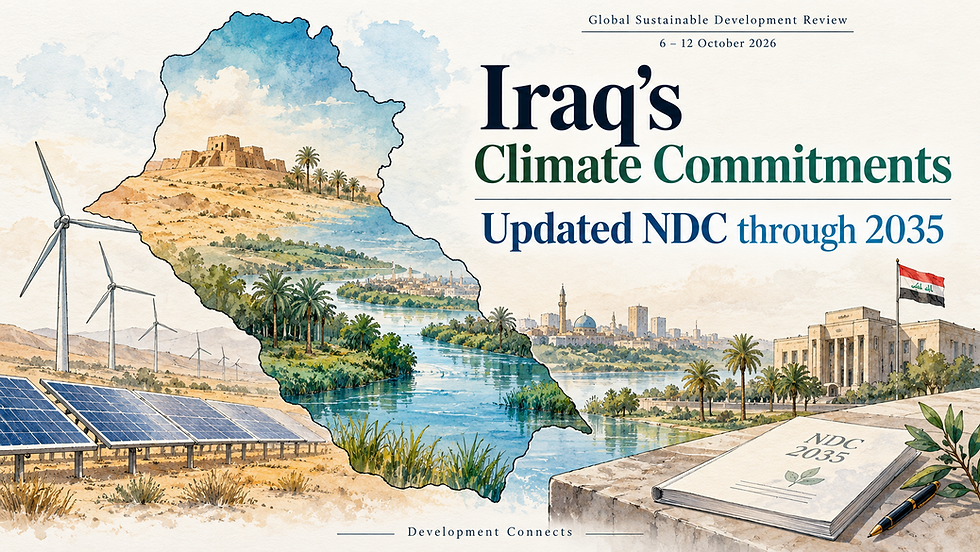
Iraq launched an updated Nationally Determined Contribution in Baghdad in October 2026, following its submission to the UN Framework Convention on Climate Change in November 2025. The update was coordinated between the Ministry of Environment and UNDP, with technical assistance under the Climate Promise initiative and funding support from the United Kingdom. A nationally determined contribution is the policy framework by which a country communicates its climate action commitments under the Paris Agreement. The updated document raises Iraq's unconditional emissions-reduction target to as much as 3% below the business-as-usual level by 2030 and establishes an unconditional reduction of up to 5% below business as usual by 2035.
It specifies a further conditional reduction of up to 17% by 2035, dependent on international climate finance, technology transfer and capacity building. Taken together, the conditional and unconditional components allow a potential reduction of up to 22% below the business-as-usual pathway in 2035. These percentages refer to a modelled reference trajectory, not an absolute decrease relative to a stated historical year. The climate framework links emissions measures with the country's development concerns in energy and water security, resilience, diversification and investment. UNDP reported that its support to Iraqi climate planning extends over more than a decade.
The October event publicly launched the updated policy and discussed finance and institutional implementation. It did not verify that the 2035 reductions had already been achieved. Subsequent emissions inventories, financing records and sector-specific implementation reports are needed to track progress against the stated reference pathway. The percentages refer to mitigation commitments expressed against an estimated business- as-usual pathway. The conditional portion depends on financing, technology and capacity support, rather than being an unconditional pledge.
Primary source: https://www.undp.org/arab-states/press-releases/iraq-launches-updated-nationally-determined-contribution
18. Mongolia: Dundgovi Signs Three-Year Green Cooperation MOU
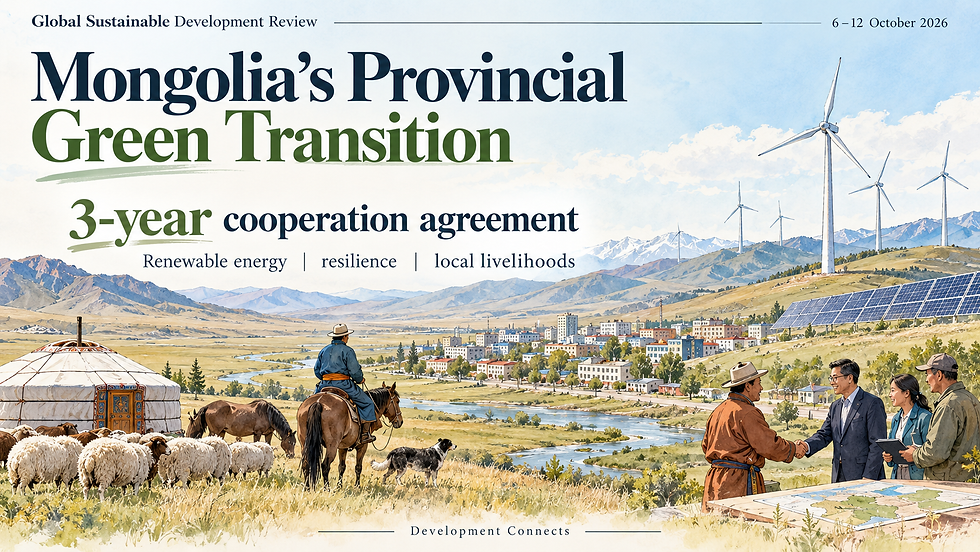
UNDP Mongolia and the Governor's Office of Dundgovi Province reported a memorandum of understanding on 6 October, signed in the province on 5 October. The three-year agreement establishes a framework for cooperation between an international development organisation and a provincial administration. Its four areas are green energy transition; climate resilience and natural- resource management; inclusive green local economic development; and digital transformation, governance and human development. The agreement is a framework for future cooperation, not confirmation of completed infrastructure investments. The release identifies opportunities for women, young people and vulnerable groups among the intended considerations for local economic development.
It also describes the role of local ownership and locally developed solutions in designing prospective activities. The cooperation arrangement can involve energy, natural resources, economic opportunities and public-service administration within the province. No quantified megawatt capacity, number of jobs or budget ceiling for this new memorandum was published in the announcement; those quantities should therefore not be attributed to it. The signing coincided with consultations for the preparation of UNDP Mongolia's Country Programme Document for 2028–2032. A consultation in Mandalgovi brought together local stakeholders to discuss climate change and environmental priorities, a green economic transition and jobs, governance and civic participation.
The October release thus reports two related activities: agreement on a three-year provincial cooperation framework and consultation feeding into a later national programme cycle. A country programme for 2028–2032 is not equivalent to the three-year provincial memorandum. Detailed investment projects, financing and indicators would need to be set out in subsequent work plans.
Primary source: https://www.undp.org/mongolia/press-releases/undp-and-dundgovi-province-strengthen-partnership-green-resilient-and-inclusive-development
19. Malawi Reviews All 17 Sustainable Development Goals

UNDP published Malawi's 2026 SDG Comprehensive Review on 7 October. The report assesses the country's progress on all 17 Sustainable Development Goals and relates that monitoring to the Malawi 2063 long-term development vision. It brings together Malawi's third Voluntary National Review and its first country-led evaluation focused on health and clean energy. These are distinct elements of national monitoring brought into one report rather than a new funding agreement for 17 separate programmes. The Voluntary National Review is Malawi's mechanism for reporting progress, constraints and policy measures under the United Nations 2030 Agenda.
The separate country-led evaluation examines selected sectors in greater depth and is intended to inform the use of evidence in public decision- making. The report draws on stakeholder consultations and received technical and financial support from UNDP and other UN partners. The sectors of health and clean energy relate to SDG 3 and SDG 7, while Malawi 2063 supplies the national planning framework. As a publication, the October review records national performance and presents recommendations for future policy and investment. The UNDP release itself does not provide one numerical improvement rate across all 17 goals, because different indicators measure different subjects and reference years.
Any claims concerning reductions in mortality, new electricity connections or household incomes should be taken from the relevant report tables with their measurement periods rather than inferred from publication of the review. The announcement establishes the date, national review cycle, evaluation scope and institutional participation. It does not assert that all SDG targets have been met.
Primary source: https://www.undp.org/malawi/publications/malawi-sdg-comprehensive-review-2026
20. South Africa Offers Community Conservation Grants

UNDP South Africa announced a new application call under the second phase of the Indigenous Peoples and Community Conserved Areas and Territories Global Support Initiative. The call is part of the Global Environment Facility Small Grants Programme and is financed by the Government of Germany through the International Climate Initiative. It invites eligible community-based and civil- society organisations in the Northern Cape to submit proposals for conservation, Indigenous knowledge and sustainable livelihood activities. A project may receive up to US$30,000, subject to selection and approval.
The named eligible municipalities are Richtersveld, Nama-Khoi, Kamiesberg and Hantam. Dawid Kruiper is also identified as a priority area, particularly for initiatives involving the ǂKhomani San community and its cultural landscape. Eligible applicants include registered NGOs, community-based organisations, civil-society organisations and academic or research institutions working with local communities. The call excludes private companies and government bodies as applicants. Applications must use the programme's published forms and meet its supporting-document requirements. Project implementation periods are expected to range from 12 to 18 months. The application deadline is 5 November 2026 at 23:59 South African Standard Time.
Priorities include community-led conservation, sustainable land management, responses to water scarcity, climate resilience and appropriate use of Indigenous and local knowledge. The programme calls for participation by women and young people and encourages community contributions and partnerships. The US$30,000 ceiling is not the value of a grant already disbursed to every applicant, and publication of the call does not establish how many projects will ultimately receive funding. A project proposal must demonstrate community participation and a practical conservation or livelihood activity in the stated geographical area.
The submission requirement does not constitute an award decision.
Primary source: https://www.undp.org/south-africa/blog/gef-small-grants-programme-opens-call-community-led-conservation-projects-northern-cape
Editorial convention: forecasts, historical data, programme targets and commitments retain their stated status and reference periods. Development Connects | www.dcdt.net
Comments