


Nira and The God Who Misplaced Magic : Part 6
- Development Connects

- Aug 8
- 6 min read
THE FOREST THAT CHARGED RENT FOR AIR
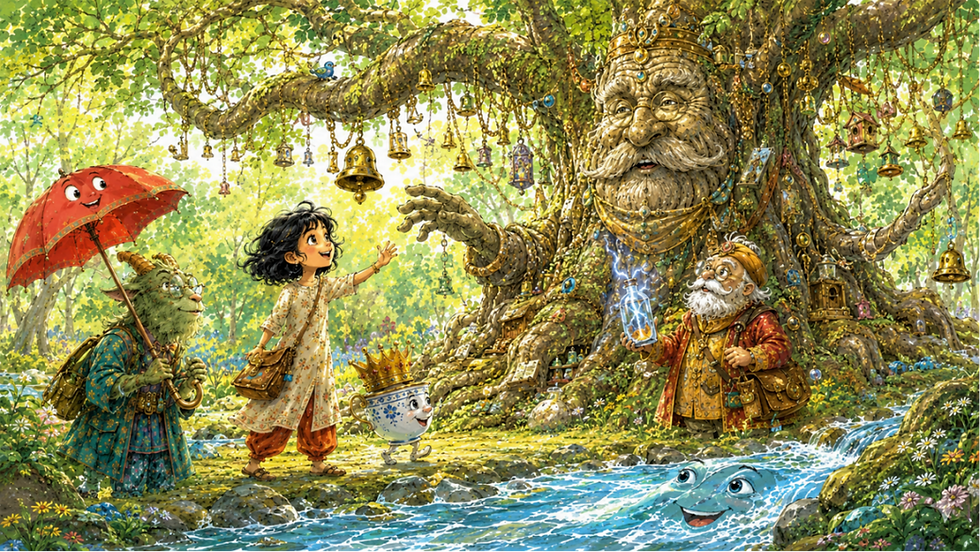
At the entrance to Hawamahal Forest stood a ticket counter beneath an arch made of vines, brass pipes and official notices. Behind the counter sat a cactus wearing spectacles, a clerk’s cap and three sharpened pencils tucked between his spines. He looked at us as if breathing were a suspicious activity.
“How many breaths do you intend to take?” he asked. “I don’t know,” I said.
“Approximate.”
“Perhaps twenty thousand?”
He opened a thick register. “Personal, commercial or recreational breathing?”
“Ordinary breathing.”
The cactus frowned. “There is no ordinary category. Air is a premium forest service.”
We were each given a small brass Breath Meter to hang around our necks. Every time anyone inhaled, the meter clicked and added another charge. Tipu was allowed a half-price rate because teacups breathe mostly through steam. Professor Bhokambol was charged extra for chewing while inhaling, which the cactus classified as combined consumption. Chhataram objected that umbrellas did not breathe at all, but the clerk charged him for “atmospheric occupation.”
Hawamahal Forest had once belonged to its trees, streams, animals, fungi, insects and winds. Now a polished board announced that it was managed by the Banyan Bank and Atmospheric Holdings Corporation. Its chairman, Sir Bargad Prasad, was an enormous banyan tree whose trunk was covered with brass plaques, hanging files and a golden nameplate nailed into his bark.
“We have modernised air,” Sir Bargad explained. “Previously, oxygen wandered about freely without accounts, receipts or responsibility. Now every breath can be measured, priced and properly appreciated.”
Birds rented branches by the hour. Clouds paid parking fees before floating over the canopy. Sunlight was available through monthly subscription, with an additional charge for golden evening light. Even shade was divided into Standard, Premium and Royal Cooling.
The river had gone on strike.
Across its dry bed stood a large board:
NO FLOW WITHOUT FAIR TERMS.
We found the river sitting beneath a bridge, knitting a blue scarf from the small amount of water she had kept for herself. Her voice sounded like pebbles rolling in a shallow stream.
“They charge me movement tax,” she said. “Then source tax, bend tax, fish-hosting tax and destination tax. Last month they fined me for exceeding my permitted wetness.”
“What happens to the forest without you?” I asked.
“Sir Bargad says water can be imported in decorative bottles.”
Just then, the invisible footprint we had brought from Padukapur began walking ahead of us by itself. We followed its glowing marks until it stopped before a fenced field full of artificial trees made of paper. Painted leaves hung from wires. Loudspeakers played recordings of birds. Plastic flowers carried labels proudly announcing that they required no bees, soil, rain or inconvenient seasons.
“This is the Future Forest,” said Sir Bargad, appearing behind us. “Predictable, profitable and entirely free from roots.” “Paper is made from trees,” I pointed out. “An excellent example of the circular economy,” he replied. “Where did the original trees go?” Sir Bargad coughed several leaves and suddenly became interested in a distant cloud.
Beyond the fence, we found rows of stumps. The remaining trees whispered that Sir Bargad had once heard a prophecy: one day the forest would choose a leader with no branches. Terrified of losing his position, he had sold sections of the forest, trapped the winds inside turbines and ordered every sapling to submit a five-year growth plan before producing its third leaf.
“Why didn’t you resist?” I asked. “We did,” said an old sal tree. “But resistance requires communication. The birds who carried our messages could no longer afford branch rent.”
At dusk, Jhilmil called an emergency meeting. Fireflies lit the stumps like tiny lamps. Mushrooms spoke through underground networks. Termites carried messages inside old furniture. Clouds attended from beyond the taxable boundary, where they hovered without paying. Kabir sat on a root with his unfinished song. Chhataram listened carefully, though he kept one eye on the weather.
Professor Bhokambol proposed writing a strongly worded academic paper. “How long will publication take?” asked the mushrooms. “Three to five years.” “We may be soup by then,” they replied. Kabir suggested a song. Chhataram suggested rain. The river suggested refusing to be decorative. Then the smallest blade of grass in the meeting raised her voice.
“Sir Bargad sells air,” she said. “But who makes it?” The leaves rustled uneasily. Every green plant in the forest helped produce the air, yet only Banyan Bank issued the bills. Moss worked between stones. Algae worked in water. Grass worked beside roads. Leaves worked from sunrise to sunset without salaries, invoices or even lunch breaks.
“Then stop production,” I said. The plants gasped. “Stop photosynthesis?” “For one minute.” “That would be irresponsible,” squeaked Sir Bargad’s accountants, a row of nervous squirrels carrying tiny ledgers. “So is charging the makers for using their own product,” I said.
At exactly noon the next day, every leaf in Hawamahal Forest folded itself. Grass stopped.
Moss stopped. Algae stopped. Even a coriander plant in the cafeteria joined the strike after placing a tiny notice beside the chutney.
The Breath Meters clicked more slowly. The air grew heavy and stale. Birds stopped singing because singing required too much breath. The squirrels loosened their collars. Sir Bargad ordered the paper trees to begin emergency oxygen production. The paper trees opened their instruction manuals, studied them seriously and produced only footnotes.
“Restart immediately!” Sir Bargad commanded. “Terms?” asked the sal tree. “I am the owner of the air!” At that moment, a wind escaped from one of the turbines and shouted, “Catch me, then!”
The other imprisoned winds broke free. They raced through the forest, rattling windows, overturning payment counters and spinning Sir Bargad’s official files into a cyclone. Air invoices flew between the trees. As each paper touched the ground, it transformed into the tree from which it had originally been made.
Saplings burst out of account books. Branches pushed through contracts. A teak desk grew roots, shook off its drawers and announced that it was resigning from office duty. A stack of receipts became a bamboo grove that immediately began arguing with the filing cabinets.
Sir Bargad wrapped his hanging roots around the Breath Meter headquarters. “You will destroy the economy!” he cried. The river rose beneath the bridge. “An economy unable to survive breathing is already holding its breath,” she said. Then she released herself.
Water rushed through the dry bed and poured across the forest. Fish returned in silver flashes. Frogs resumed unfinished conversations. Clouds entered without paying parking fees. The recorded birds in the paper forest continued singing perfect notes until real birds drowned them out with louder, less accurate and much happier music.
Sir Bargad’s final defence was the Great Air Vault, a tall glass tower filled with thousands of bottles marked PREMIUM FOREST BREEZE. He locked himself inside and declared, “There is enough air here for one hundred years!”
Unfortunately, the bottles contained advertising fragrance rather than oxygen. Sir Bargad emerged after thirty seconds, coughing perfume and looking considerably less certain.The plants unfolded their leaves and resumed photosynthesis. The first fresh breath moved through the forest like a cool wave. Breath Meters stopped clicking. Some fell apart from embarrassment.
A new agreement was written, though Professor Bhokambol was not allowed to eat it. The agreement declared air, water, shade, pollination and birdsong to be shared living processes rather than products belonging to one chairman. Birds received permanent nesting rights. Clouds could park freely. Saplings no longer needed permission to grow in unexpected directions.
Sir Bargad remained head of Banyan Bank, but the bank’s purpose changed completely. It now stored seeds, rainwater, community memory and emergency snacks for migrating parrots. The river agreed to return to work on the condition that nobody described her bends as inefficiency.
The invisible footprint rose from the wet ground and stepped into a small storm cloud. The cloud shrank until it was small enough to fit beneath Chhataram’s red canopy. Thunder rattled inside his ribs.
Words flashed across the cloud: WHEN AIR IS FREE AND RIVERS RUN,TAKE BOTTLED THUNDER TO THE MACHINETHAT COUNTS ALL THINGS BUT UNDERSTANDS NONE.
That evening, we sat beside the restored river. Kabir played his unfinished song. Fireflies blinked in rhythm. Tipu filled himself with ginger tea. The forest smelled of wet bark, new leaves and recently cancelled invoices. I asked Sir Bargad why he had wanted to own everything. He looked towards the young saplings.
“I thought ownership would prevent loss.”
“Did it?”
“No,” he said. “It merely made every leaf afraid of me.”
Before sleeping, I checked our impossible clues: the hiccup of the unopened door, the song of the unripe star, the Chalk-Dust Compass, the Missing Minute, the invisible footprint and now the bottled thunder.
Six impossibilities. Somewhere ahead stood a machine that knew everything. I hoped it knew the road to the God of Magic. Professor Bhokambol hoped it knew where to find a well-written conclusion. Chhataram hoped it could finally explain the weather. The thunder inside him laughed so loudly that, for half an hour, rain fell upward and the clouds had to open umbrellas.


Comments